Why check clinic reviews before going abroad
TL;DR:
- Clinic reviews provide insights into patient experiences with staff and service quality but do not reliably assess clinical skill or safety. To make informed decisions, consider patterns over time, specific details, verified feedback platforms, and recent reviews; always supplement reviews with accreditation, credentials, and clear communication. Thorough research and layered evidence help ensure safe, trustworthy treatment abroad, prioritising qualified clinics with strong aftercare policies.
Planning a medical procedure abroad is one of the most significant decisions you can make for your health and your finances. Knowing why check clinic reviews matters before you commit could be the difference between a successful outcome and a costly, dangerous mistake. Most patients look at reviews before booking healthcare, yet fewer than half rely on them exclusively, and for good reason. Reviews tell part of the story. Understanding how to read, compare, and contextualise clinic reviews alongside other evidence is what separates genuinely safe choices from ones that simply look good on paper.
Table of Contents
- Key takeaways
- Why clinic reviews matter and their limits
- How to read clinic reviews effectively
- Beyond reviews: comparing clinics properly
- Applying review research to your decision
- My honest perspective on reading clinic reviews
- Find verified clinics with Clinicgroup
- FAQ
Key takeaways
| Point | Details |
|---|---|
| Reviews reflect experience, not skill | Patient reviews measure communication and empathy, not a surgeon’s technical competence. |
| Patterns matter more than ratings | Look for consistent feedback across many reviews over time, not just star averages. |
| Fake reviews are a real risk | Sudden rating spikes and vague praise are warning signs of manipulated or incentivised feedback. |
| Accreditation supplements reviews | ISO 9001 and JCI accreditation standards verify clinical quality in ways patient reviews cannot. |
| Use a layered decision process | Combine review analysis with credential checks, transparent pricing, and aftercare policies. |
Why clinic reviews matter and their limits
Understanding why comparative clinic reviews matter starts with knowing what they can and cannot tell you. This distinction is especially relevant when you are considering treatment in another country, where you cannot simply pop in for a preliminary visit.
Patient reviews are a reliable window into the human side of a clinic. They reflect whether staff were welcoming, whether waiting times were reasonable, whether the facilities felt clean, and whether patients felt heard. These are genuinely important factors. A clinic where patients consistently report warm, attentive care is likely one where communication is prioritised.
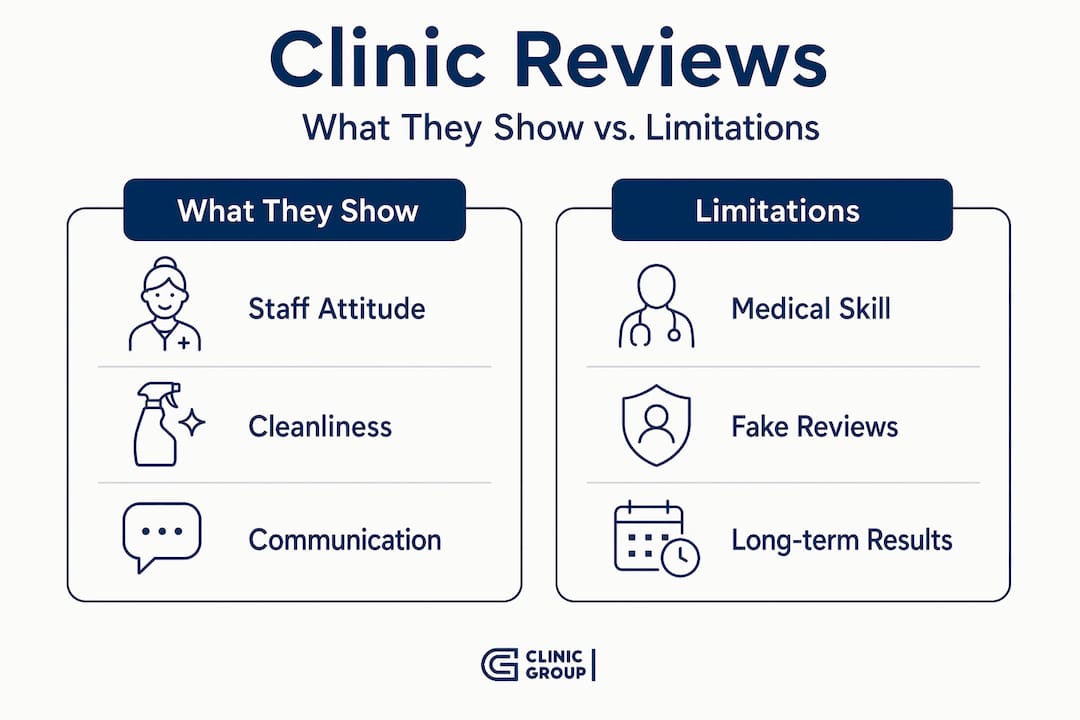
What reviews cannot reliably measure is clinical competence. Whether a dentist has correctly placed an implant at the right angle, whether a surgeon has followed sterile technique throughout a procedure, whether the anaesthesia protocol was appropriate. These are technical matters that a non-clinical patient is simply not equipped to assess. A satisfied patient who had no complications may leave a glowing review without ever knowing whether corners were cut behind the scenes.
There is also the matter of emotional bias. Patients who had an unusually positive or unusually negative experience are far more likely to leave a review than those with average outcomes. This means a clinic’s online rating can be skewed in either direction by a minority of outlier experiences. Add to this the well-documented problem of fake or incentivised reviews, and it becomes clear that the importance of clinic reviews lies not in their face value, but in how thoughtfully you interpret them.
- Reviews reflect empathy, communication, and service quality.
- They cannot assess surgical skill, sterile protocols, or clinical decision-making.
- Star ratings can be skewed by extreme experiences or fake submissions.
- Only a portion of patients rely solely on reviews for healthcare decisions.
- Emotional bias means positive experiences are often over-represented.
Pro Tip: Never judge a clinic on fewer than 30 reviews. Below that threshold, a handful of fake or outlier responses can move the average significantly.
How to read clinic reviews effectively
The benefits of reading reviews come through only when you know what to look for. Here is a practical framework for evaluating what you find.
-
Look for patterns, not peaks. A clinic with 200 reviews averaging 4.3 stars over three years is a far more reliable signal than one with 50 reviews averaging 5 stars accumulated in the last six months. Consistent volume over time is the strongest indicator of genuine patient satisfaction.
-
Value specificity over praise. Generic comments such as “amazing experience” or “highly recommend” reveal very little. Reviews that mention specific staff members by name, describe the consultation process in detail, or reference particular procedures are significantly more credible. Specific, verifiable details in a review increase its trustworthiness considerably.
-
Use verified platforms. Verified patient review systems substantially improve the reliability of feedback compared to anonymous postings. Platforms that confirm a reviewer actually received treatment at a facility carry more evidential weight.
-
Check the recency of reviews. A clinic can change ownership, management, or clinical staff. Reviews from three or four years ago may no longer reflect current standards. Prioritise feedback from the past 12 to 18 months.
-
Read the negative reviews carefully. This is perhaps the most counter-intuitive step, but how a clinic responds to criticism tells you a great deal about its commitment to patient care. A professional, empathetic response to a complaint demonstrates accountability. Defensive or dismissive replies are a red flag.
-
Compare reviews across multiple platforms. A clinic that scores well on one site but poorly on another warrants scrutiny. Cross-referencing Google, Trustpilot, and specialist medical tourism platforms gives you a broader, more balanced picture.
Pro Tip: Search the clinic name alongside words like “complaint,” “problem,” or “infection” in a general search engine. This surfaces forum discussions and blog posts that formal review platforms may not capture.
Beyond reviews: comparing clinics properly
Knowing how to compare clinics means looking past the review section entirely for at least part of your research. Reviews are one layer of evidence. Accreditation, credentials, and operational policies are others, and they carry significant weight.
| Factor | What to look for | Why it matters |
|---|---|---|
| Accreditation | ISO 9001 certification, JCI accreditation | JCI accreditation is reviewed every three years and verifies patient safety standards |
| Hospital affiliation | Whether the clinic operates within or alongside an accredited hospital | Hospital-integrated clinics provide access to emergency facilities and standardised protocols |
| Transparent pricing | Itemised cost breakdowns, no hidden fees | Protects against unexpected expenses mid-treatment |
| Surgeon credentials | Board certification, years of specialised experience | Confirms clinical competence that reviews cannot |
| Aftercare policy | Written follow-up plan, remote consultation access | Reduces risk of complications going unaddressed post-travel |
| Communication quality | Responsiveness, thoroughness of pre-treatment consultation | Indicates patient-centred approach and reduces misunderstanding |
Understanding why compare clinic packages matters becomes clear when you realise that price differences between clinics abroad can vary by thousands of pounds, sometimes reflecting quality gaps, sometimes simply reflecting different cost-of-living contexts. A clinic in Albania offering dental implants at a fraction of UK prices is not automatically inferior, but you need the evidence beyond price to confirm that. Explore the benefits and risks of dental travel to build a fuller picture before committing.
For medical tourists, the clinic accreditation guide published by Clinicgroup provides clear guidance on what certifications to ask for and how to verify them independently.
Applying review research to your decision
Once you understand how to find clinic reviews and what to do with them, the final step is building them into a structured decision process. Here is how to do that practically.
- Start with three to five shortlisted clinics. Do not try to research twenty at once. Use an initial filter based on treatment type, location, and accreditation status to produce a manageable shortlist.
- Request a written consultation before travelling. Reputable clinics will offer a remote consultation, sometimes via video call, and provide a written treatment plan. This tests their communication quality and their willingness to be transparent about costs and procedures.
- Ask the clinic directly about their reviews. Ask how they collect patient feedback, whether reviews are independently verified, and how they handle complaints. A clinic confident in its quality standards will answer these questions openly.
- Balance cost savings against verified quality. It is entirely reasonable to save significantly on treatment abroad. The key is that savings should not come at the expense of confirmed safety standards. Verified accreditation, experienced practitioners, and strong aftercare provision are non-negotiable.
- Plan your aftercare before you travel. Understand what follow-up support the clinic offers remotely after you return home. This is particularly relevant for procedures like dental implants, hair transplants, or cosmetic surgery where complications can emerge weeks later. The aftercare services available to medical tourists vary considerably between providers.
- Cross-reference what patients say about aftercare. Reviews that specifically mention post-treatment support are among the most useful you will read. They confirm whether the clinic’s aftercare promises match the reality patients experienced.
My honest perspective on reading clinic reviews
I have worked with patients who arrived at Clinicgroup after making poor choices elsewhere, and the pattern is almost always the same. They found a clinic with impressive photos, a polished website, and a strong star rating. They did not read the detail in the reviews. They did not check whether the facility held any recognised accreditation. They booked based on price and surface-level reassurance.

What I have learned is that savvy patients treat reviews the way a detective treats witness statements. Useful, sometimes revealing, but never the whole story. The most telling reviews are often the neutral ones. The patient who says “the result was fine but communication was slow and aftercare felt rushed” is giving you far more useful information than the one who says “absolutely perfect, would recommend to everyone.”
I also think patients underestimate how much they can learn by simply asking clinics questions directly. A clinic that deflects, delays, or gives vague answers to reasonable pre-treatment questions is telling you something important. Confidence and transparency go hand in hand with genuine quality.
The goal is not to find a clinic with no negative reviews. That almost certainly means there are not enough reviews to be meaningful. The goal is to find a clinic whose overall picture, reviews, credentials, communication, and aftercare policies, adds up to a trustworthy, well-evidenced choice.
— Clinic
Find verified clinics with Clinicgroup
Clinicgroup connects patients from the UK and across Europe with verified clinics in Albania and Dubai, covering dental treatments, hair transplants, cosmetic surgery, and wellness programmes. Every clinic in the network is assessed against clear quality standards, so you are not left relying on reviews alone. Patients receive full support throughout their journey, including clinic matching, travel arrangements, partner hotel options, and structured aftercare. Transparent pricing and genuine patient feedback are central to how Clinicgroup operates. If you are ready to explore your options with confidence, browse the full range of available treatments or visit Clinicgroup to begin your consultation.
FAQ
What do clinic reviews actually tell you?
Clinic reviews reliably reflect the patient experience, including communication, staff attitude, and service quality, but they cannot assess clinical skill or technical outcomes. Use them as one source of evidence, not the only one.
How do you spot fake or unreliable clinic reviews?
Look for vague, non-specific praise, sudden spikes in five-star ratings, and reviewers with no history of other reviews. Specific details such as staff names, procedure descriptions, and dates are strong indicators of genuine feedback.
Why does accreditation matter more than reviews for safety?
Accreditations like JCI and ISO 9001 are independently verified against clinical and safety standards. Reviews reflect individual perceptions; accreditation confirms that a clinic meets recognised quality benchmarks regardless of patient sentiment.
How many reviews should a clinic have before you trust them?
A minimum of 30 reviews spread over at least 12 months provides a statistically meaningful picture. High, consistent volume over time is a far stronger signal than a perfect score based on a small number of submissions.
Should negative reviews put you off a clinic?
Not automatically. A clinic that responds to negative feedback professionally and constructively demonstrates patient-centred values. The absence of any negative reviews is itself a potential warning sign of a filtered or manipulated review profile.