Clinic accreditation guide: ensuring safe medical tourism
TL;DR:
- Accreditation is an independent review confirming safety and quality systems, not a guarantee of perfect outcomes.
- Patients should verify accreditation claims directly through official directories and confirm it covers their specific procedure.
- Accreditation complements, but does not replace, verifying clinician credentials, aftercare plans, and managing clinical risks.
Clinic accreditation is widely cited as a marker of quality, yet many patients travelling abroad for cosmetic or dental procedures misunderstand what it actually means. Accreditation is an independent review process in which an accrediting body checks whether a healthcare organisation meets published quality and patient-safety standards. It is not a certificate of perfection or a promise that every procedure will go smoothly. For medical tourists, understanding this distinction is essential. This guide explains exactly what accreditation is, which clinics qualify, what it can and cannot deliver, and how you can verify claims before you book treatment abroad.
Table of Contents
- What clinic accreditation means and how it works
- Types of clinic accreditation and who accredits clinics
- What clinic accreditation can (and cannot) guarantee
- How to verify clinic accreditation before your medical trip
- Why the ‘accreditation equals safety’ myth misses crucial details
- Find accredited clinics and support for safer medical tourism
- Frequently asked questions
Key Takeaways
| Point | Details |
|---|---|
| Accreditation is independent | An accrediting body objectively reviews clinics for safety and quality standards, beyond routine licensing. |
| Scope covers cosmetic and dental | Ambulatory clinics, including those offering cosmetic and dental procedures, can achieve accreditation if they meet standards. |
| Accreditation is not a guarantee | Accredited clinics still carry risks; comprehensive due diligence and aftercare planning are essential. |
| Verification is vital | Always check a clinic’s accreditation is genuine and current using public directories or accreditor contacts. |
What clinic accreditation means and how it works
Accreditation is often mentioned in clinic marketing materials, but rarely explained in plain terms. At its core, accreditation verifies quality systems through on-site visits, documentation reviews, and direct observation of care processes. An accrediting body, which is an independent organisation with no financial stake in the clinic’s success, evaluates whether the facility meets a published set of standards covering everything from sterilisation protocols to patient record management.
The accreditation process typically unfolds in three phases:
-
Application and self-assessment. The clinic completes a detailed self-evaluation against the accrediting body’s published standards. This forces internal teams to identify gaps in their processes before any external visit occurs.
-
On-site survey. Trained assessors visit the clinic in person. They observe procedures, interview staff, inspect facilities, and review patient records. This is not a checklist exercise. Assessors look for evidence that good practice is embedded in the clinic’s everyday culture, not just demonstrated on the day of the visit.
-
Decision and ongoing monitoring. If the clinic meets the required standards, accreditation is awarded. Most accreditation cycles run for three years, after which the clinic must undergo a full re-assessment to retain its status. Many accrediting bodies also conduct unannounced interim checks.
Why accreditation differs from licensing:
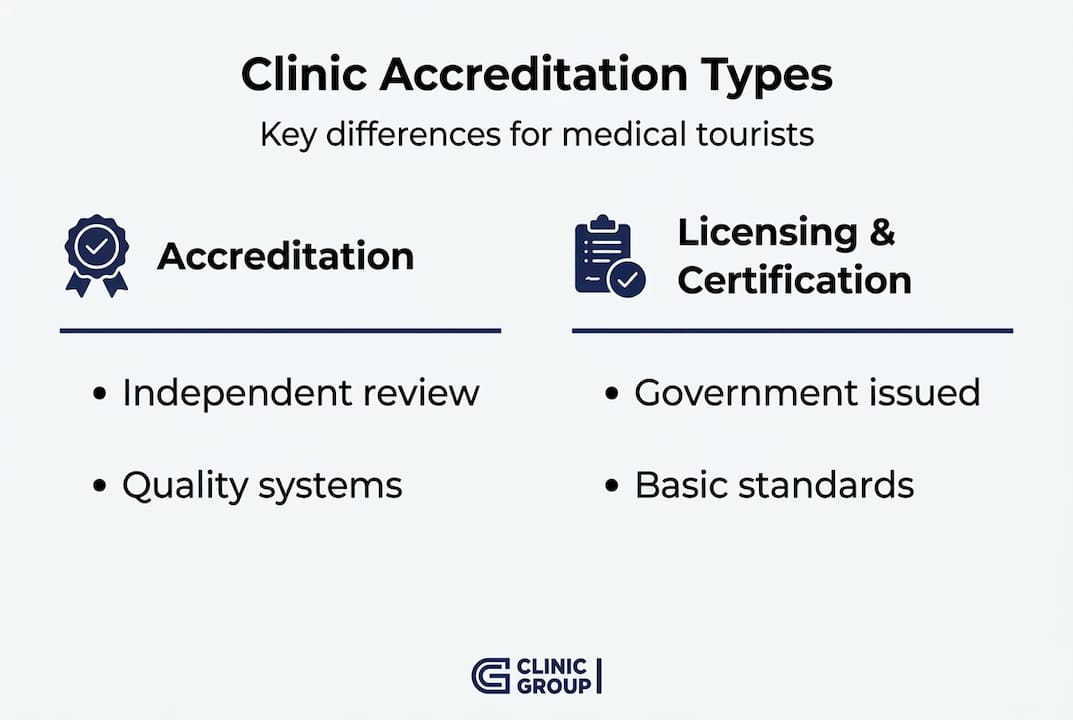
This is where many patients get confused. A clinic licence is granted by a government body and confirms that the facility is legally permitted to operate. Regulated clinic care under national rules is the minimum bar, not a quality benchmark. Accreditation is a voluntary, additional layer. A clinic can hold a valid licence and still deliver inconsistent care. Accreditation, when genuine, means an independent body has assessed whether the facility’s safety systems, training procedures, and quality controls meet a recognised standard.
| Feature | Licensing | Accreditation |
|---|---|---|
| Granted by | Government authority | Independent accrediting body |
| Mandatory? | Yes | Voluntary |
| Frequency | Usually annual renewal | Typically three-year cycle |
| Focus | Legal permission to operate | Quality and safety systems |
| Visibility | Public register | Accreditor’s directory |
For patients browsing our clinic directory, filtering for accredited facilities is a sensible starting point, but it should be the beginning of your research, not the end of it.
Pro Tip: Ask any clinic to name their specific accrediting body. Then search that body’s public directory yourself to confirm the listing is active and covers the type of procedure you are planning.
Types of clinic accreditation and who accredits clinics
Now that you know what accreditation involves, it is crucial to recognise the types of clinics it covers and which organisations accredit them.
A widespread misconception is that accreditation applies only to large hospitals. In reality, ambulatory care clinics including cosmetic surgery centres and dental clinics are fully eligible for accreditation under dedicated standards. An ambulatory care setting is any facility where patients receive treatment and are discharged on the same day, which covers the vast majority of cosmetic and dental procedures.
Major accrediting organisations you should know:
-
Joint Commission International (JCI). Widely regarded as the gold standard for international healthcare accreditation, JCI operates in more than 100 countries. A JCI-accredited clinic has met rigorous international patient safety goals covering areas such as medication safety, infection control, and surgical verification.
-
Accreditation Commission for Health Care (ACHC). Primarily US-based but internationally recognised, ACHC accredits ambulatory care and home health settings. It distinguishes between facility-level accreditation and programme-level accreditation, which is an important nuance explained below.
-
International Society for Quality in Health Care (ISQua). ISQua accredits the accrediting bodies themselves, so if your clinic’s accreditor holds ISQua recognition, that is a meaningful additional signal of credibility.
-
National bodies. Many European countries have domestic accrediting organisations, such as the Health Quality Service (HQS) in the UK or the Haute Autorité de Santé (HAS) in France. These carry weight within their national systems but may be less familiar to international patients.
Facility vs programme accreditation: an important distinction
Facility accreditation means the entire clinic meets quality standards across all its services. Programme accreditation is narrower, covering only a specific service or unit within that clinic. For example, a clinic might hold accreditation for its oncology programme without that accreditation covering its cosmetic surgery department. Always verify that accreditation applies to the specific procedure you intend to have. Our safe dental clinic guide discusses this distinction in detail for patients planning dental work abroad.
Comparison: accreditation, certification, and licensing
| Mechanism | Who issues it | Scope | Relevance for tourists |
|---|---|---|---|
| Accreditation | Independent body | Systems and processes | High, if scope matches your procedure |
| Certification | Professional body or manufacturer | Clinical skill or product | Moderate, confirms specific competency |
| Licensing | Government | Legal permission to operate | Baseline minimum |
| Membership | Trade association | Peer affiliation | Lower; self-selected |
Understanding these distinctions helps you ask better questions and avoids being reassured by credentials that do not directly address the safety of your planned procedure.
What clinic accreditation can (and cannot) guarantee
Understanding who accredits clinics, it is vital to evaluate what accreditation actually delivers for patient safety and outcomes, especially for medical tourists.
Accreditation provides meaningful reassurance in several areas. When a clinic is genuinely accredited, you can reasonably expect that:
- Infection control protocols are documented and verified by an external reviewer.
- Staff credentials and training records are maintained and checked against published standards.
- Emergency response procedures are in place and have been tested or reviewed during the assessment.
- Patient records are stored securely and are accessible to the clinical team when needed.
- Consent processes are structured and comply with published guidelines.
These are not trivial assurances. Many complications in cosmetic and dental procedures arise from preventable process failures, such as inadequate sterilisation, poor medication management, or insufficient pre-operative screening. A properly accredited clinic has systems designed to prevent these failures.
However, accreditation cannot guarantee your personal outcome.
“Accreditation provides a structured, standardised external evaluation of quality and patient-safety systems, but it does not eliminate clinical risk.” Published clinical series on cosmetic tourism complications show that complication burdens in inbound cosmetic tourists can be substantial, even when patients have selected facilities they believed to be reputable.
The research on cosmetic medical tourism is instructive here. A 12-year review of inbound cosmetic tourism complications found that revision surgery, infections, and wound healing problems are recurring issues across a range of procedures, including liposuction, breast augmentation, and rhinoplasty. These complications occurred not because patients had chosen obviously substandard clinics, but because individual clinical risk and surgical skill are not things that any accreditation framework can fully standardise.
There are additional factors that accreditation does not routinely evaluate:
- The individual surgeon’s or dentist’s personal complication rate and years of experience in your specific procedure.
- Whether the clinic has robust protocols for managing complications after you return home, which is the most vulnerable period for medical tourists.
- The quality of communication between the clinic abroad and your GP or specialist at home.
- Whether follow-up appointments are genuinely available or simply listed in a brochure.
This is why reviewing aftercare services and understanding how to navigate medical consultations abroad are as important as any accreditation check. Exploring available treatments through a platform that prioritises transparency about these factors is a practical step in the right direction.
How to verify clinic accreditation before your medical trip
Now that you understand both the value and limits of clinic accreditation, here is how you can directly verify claims before your medical trip.
The most important principle is straightforward: treat any accreditation claim as something you must validate yourself. Treat accreditation as a claim to verify, confirming it is real, current, and covers the specific services you want by using the accreditor’s public directory or contacting the accreditor directly.
Step-by-step verification process:
-
Step 1: Ask the clinic for their accreditor’s full name. A vague answer such as “we are internationally accredited” is not sufficient. You need the specific name of the accrediting body and the accreditation reference number if one is provided.
-
Step 2: Visit the accreditor’s public directory. JCI, ACHC, and most major accrediting bodies maintain searchable online directories of currently accredited organisations. Search for the clinic by name and location.
-
Step 3: Confirm the accreditation is current. Check the expiry or renewal date. Accreditation awarded three or four years ago without a recent renewal may have lapsed.
-
Step 4: Confirm the scope covers your procedure. If you are having a rhinoplasty, check that the accreditation covers surgical ambulatory care, not just the clinic’s laboratory services or administrative systems.
-
Step 5: Cross-reference with patient reviews and independent sources. Patient reviews on verified platforms, combined with accreditation status, give you a fuller picture. One or two negative reviews mentioning communication problems or poor aftercare are worth taking seriously even if accreditation is confirmed.
-
Step 6: Check the clinician’s individual credentials. Accreditation covers the facility, not the individual practitioner. Confirm your surgeon or dentist is registered with the relevant professional body in their country and has documented experience in your planned procedure.
Additional resources:
- JCI’s searchable directory is available at jointcommissioninternational.org.
- ISQua publishes a list of recognised accrediting bodies at isqua.org.
- Many national health ministries maintain registers of licensed and accredited facilities.
Pro Tip: Always ask the clinic directly how they manage complications that arise after you have returned home. A clinic confident in its aftercare will answer this question clearly and in detail. Vague or deflective answers are a significant warning sign, regardless of accreditation status.
Our clinic directory includes verified information on accreditation status and is supported by the team at Clinic Group to help you cross-check credentials with confidence.
Why the ‘accreditation equals safety’ myth misses crucial details
We work with patients across Europe and the Middle East who have done considerable research before contacting us. A pattern that appears regularly is a firm belief that an accredited clinic is essentially a safe clinic, full stop. That belief, while understandable, leaves important gaps in your due diligence.
Accreditation tells you that the clinic’s systems were assessed and met published standards at the time of evaluation. It does not tell you about the surgeon who joined the team six months after that assessment, the aftercare coordinator who left, or the specific outcomes for patients who had the same procedure you are planning. Published evidence confirms that cosmetic tourism complications can be substantial even in facilities patients selected on the basis of perceived quality.
The most effective approach treats accreditation as one signal among several. Alongside it, you should verify individual clinician credentials, ask specific questions about complication management, review the clinic’s track record in your planned procedure, and understand your comprehensive treatment options before committing to any single facility. Accreditation narrows the field. Sound judgement, informed by evidence, should make your final decision.
Find accredited clinics and support for safer medical tourism
If you want more support in finding safe, accredited clinics for your medical journey, here is how Clinic Group can help. Our platform connects patients with verified clinics across Europe and the Middle East, covering cosmetic surgery, dentistry, hair transplants, and a range of other procedures. You can browse our full range of treatment options and compare clinics based on accreditation status, patient reviews, and treatment specialisms. The Clinic Group platform also provides direct support throughout your journey, from initial consultation and clinic selection through to aftercare coordination and second opinions, so that safety and transparency remain central at every stage.
Frequently asked questions
How is clinic accreditation different from licensing?
Clinic accreditation is an independent quality review conducted by a recognised accrediting body, while licensing is government regulation and permission to operate; accreditation adds an extra, voluntary layer of safety verification above the legal minimum.
Can a dental or cosmetic clinic be accredited?
Yes, ambulatory care clinics including dental and cosmetic facilities are fully eligible for accreditation under dedicated standards, provided they meet the published requirements of a recognised accrediting body.
Does accreditation mean a clinic is completely safe?
No. Accreditation confirms that quality systems are externally verified, but complication burdens in cosmetic tourism can still be significant; due diligence covering clinician credentials, aftercare, and complication management remains essential.
How can I verify a clinic’s accreditation?
Validate the accreditation claim by searching the accrediting body’s public online directory or contacting the accreditor directly to confirm the listing is current and covers the specific procedure you are planning.