How to navigate medical consultations abroad safely

Seeking medical treatment abroad can save you thousands of pounds, but the risks are frequently underestimated. A 14% complication rate in dental tourism alone reveals how quickly a cost-saving decision can become a costly problem. Cosmetic surgery, dentistry, and wellness treatments all carry specific risks when managed across borders, and the consultation process sits at the heart of safe outcomes. This guide walks you through every stage, from initial enquiry to aftercare planning, so you can make informed decisions and protect both your health and your finances.
Table of Contents
- Understanding the medical consultation process abroad
- Evaluating clinic credentials and practitioner expertise
- Risks, complications, and legal considerations
- Practical steps for safer medical consultations abroad
- What most guides miss about cross-border medical consultation
- Connect with trusted clinics for your next consultation
- Frequently asked questions
Key Takeaways
| Point | Details |
|---|---|
| Consultation quality matters | Thorough consultations with multiple professionals reduce overtreatment and complications. |
| Clinic accreditation is essential | JCI and ISO accreditations signal higher standards and patient safety abroad. |
| Risks are real | Complication rates can be significant for cosmetic and dental procedures; informed preparation minimises risk. |
| Factor in aftercare costs | Savings on treatment may be offset by aftercare needs; include this in your budget. |
Understanding the medical consultation process abroad
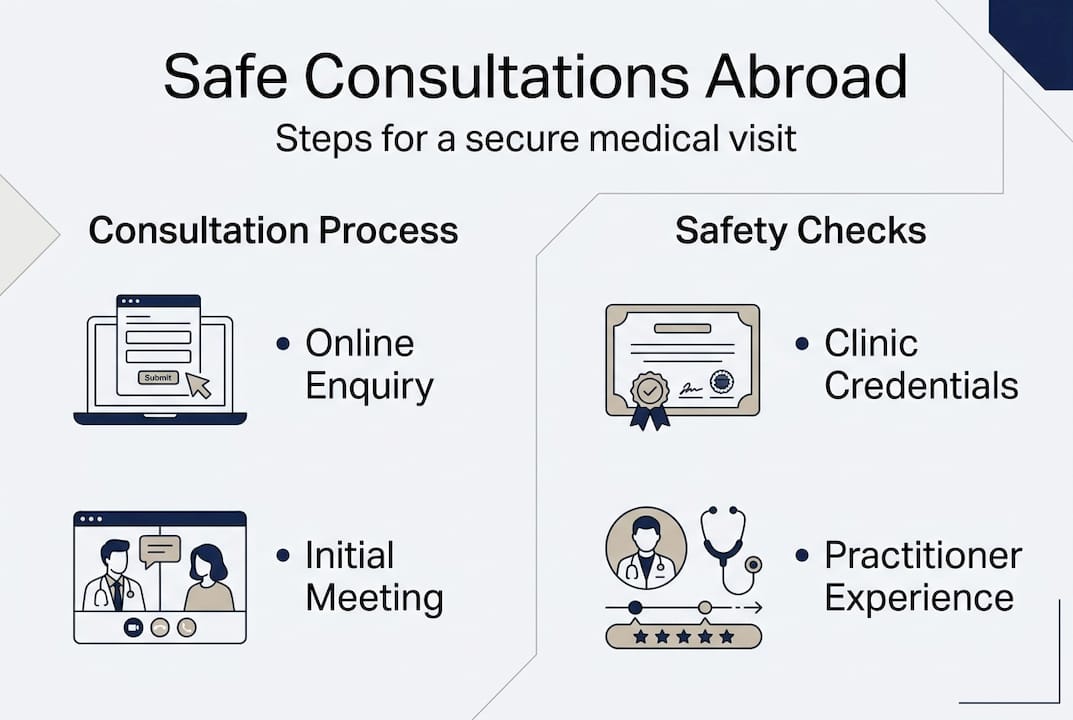
Knowing how the consultation process actually works is the essential first step before you book anything. The typical journey follows four broad stages, and understanding each one helps you spot where things can go wrong.
Stage one: Online enquiry. Most patients begin by submitting a contact form or photographs to a clinic. This stage is informal, but it sets the tone. Clinics that respond quickly with detailed, personalised information tend to be more thorough than those offering instant price quotes without reviewing your case.
Stage two: Initial consultation. This may be remote (via video call) or in-person during a dedicated travel visit. A thorough consultation covers your medical history, current medications, expectations, and a clinical assessment. Remote consultations are convenient but carry limitations, particularly for procedures requiring physical examination.
Stage three: Treatment planning. A responsible clinic produces a written treatment plan outlining the procedures, materials, timelines, and costs. This document is your reference point and should be reviewed carefully before you agree to anything.
Stage four: Post-treatment follow-up. This is where many patients encounter problems. Follow-up care across borders is logistically challenging, and clinics vary enormously in how they handle it.
The quality of consultations varies significantly. A BMJ review of Turkish clinics found that 58% recommended overtreatment, though it also confirmed a 95.2% implant survival rate at ten years when procedures were carried out correctly. This contrast matters: high technical skill does not automatically mean appropriate treatment recommendations.
“A clinic that rushes through your consultation or skips your medical history is prioritising volume over your wellbeing. Take that as a clear warning sign.”
When researching clinics, browsing a verified European clinic directory gives you a structured starting point, allowing you to compare facilities, specialisations, and patient reviews before committing to any single provider.
- Ask for a written treatment plan before any commitment
- Confirm whether the initial consultation is remote or in-person
- Check whether follow-up appointments are included in the quoted price
- Request information on the materials and implant brands used
Evaluating clinic credentials and practitioner expertise
Once you understand how consultations unfold, the next step is assessing the clinic and the practitioners themselves. Not all accreditations carry equal weight, and knowing which ones matter can protect you from poor-quality care.

Joint Commission International (JCI) and ISO certification are the two most widely recognised standards in international healthcare. JCI accreditation, in particular, signals that a clinic meets rigorous patient safety and quality benchmarks. Clinics that hold these credentials have undergone independent audits, which adds a meaningful layer of assurance.
| Accreditation | What it covers | Why it matters |
|---|---|---|
| JCI | Patient safety, clinical quality, facility standards | Internationally recognised benchmark |
| ISO 9001 | Quality management systems | Confirms consistent operational standards |
| National licences | Country-specific regulatory compliance | Minimum legal requirement |
Practitioner experience is equally important. High-volume practitioners often develop excellent technical skills, but the same volume can create pressure to recommend more procedures than necessary. Seeking clinic accreditation standards before shortlisting helps you filter out facilities that cannot demonstrate verified quality.
Pro Tip: Request the specific practitioner’s credentials, not just the clinic’s. Ask how many procedures of your type they perform each year, and look for before-and-after case studies relevant to your treatment.
Multiple consultations are one of the most effective tools you have. Prioritising accredited clinics and seeking more than one opinion significantly reduces the risk of overtreatment and gives you a clearer picture of what you genuinely need. Platforms that list high-quality clinics abroad make it easier to arrange second opinions without starting your research from scratch.
Avoid clinics that discourage questions, refuse to share practitioner profiles, or pressure you to book quickly. Transparency is a reliable indicator of quality.
Risks, complications, and legal considerations
Before arranging treatment or travel, it is vital to understand what might go wrong and how prepared you are to handle it.
Complication rates differ by treatment type and by the materials used. Infection is the most common complication across cosmetic and dental procedures. Implant failure rates tell a particularly clear story: unbranded implants fail at a rate of 8 to 12%, compared to just 2 to 3% for branded, certified products. That difference is significant when you consider the cost and discomfort of revision surgery.
| Treatment type | Common complications | Estimated complication rate |
|---|---|---|
| Dental implants (unbranded) | Implant failure, infection | 8 to 12% |
| Dental implants (branded) | Infection, minor adjustment | 2 to 3% |
| Cosmetic surgery | Infection, scarring, asymmetry | Varies by procedure |
| Wellness treatments | Adverse reactions, inadequate dosing | Lower, but present |
Aftercare is a persistent challenge. Many patients return home within days of a procedure, leaving little time for the clinic to monitor healing. If complications arise weeks later, you are managing them through your local GP, who may have limited access to your treatment records.
Legal recourse is another area where patients are often caught off guard. Outside the EU, your ability to pursue a complaint or claim compensation is considerably restricted. Even within EU member states, cross-border legal processes are slow and expensive.
- Confirm what aftercare is included and for how long
- Request full documentation of your treatment, including materials used
- Ask the clinic what happens if complications arise after you return home
- Check whether your travel insurance covers medical complications abroad
Choosing from a network of trusted healthcare providers reduces these risks by ensuring clinics have been vetted for quality, transparency, and patient support standards.
Practical steps for safer medical consultations abroad
Having understood the risks, you can now approach the consultation and treatment process with confidence. A structured approach makes a genuine difference.
- Research thoroughly before making contact. Use verified directories and patient forums to build a shortlist of clinics. Look for consistent reviews across multiple platforms, not just testimonials on the clinic’s own website.
- Prepare your medical history. Compile a clear summary of your current health, medications, allergies, and any previous relevant treatments. Share this before your consultation so the clinic can assess your suitability properly.
- Request a written treatment plan. Never agree to a procedure based on a verbal summary. A written plan should detail every step, the materials to be used, the practitioner responsible, and the total cost.
- Ask the right questions during consultation. Key questions include: What brand of implant or product will be used? What is your personal complication rate for this procedure? What follow-up is included? What happens if I experience problems after returning home?
- Plan your travel around recovery. Avoid booking flights the day after a significant procedure. Build in time for initial healing and a follow-up appointment before you travel.
- Arrange aftercare at home in advance. Speak to your local GP before you travel. Ensure they have your treatment plan and know what to look for if complications arise.
Pro Tip: Potential aftercare costs can quickly erode the savings you made abroad. Factor revision surgery, travel back to the clinic, and local GP appointments into your budget before you commit.
Reviewing available treatments on a trusted platform helps you understand what each procedure realistically involves, so you arrive at your consultation already informed.
What most guides miss about cross-border medical consultation
Most articles on medical tourism focus on price comparisons and clinic star ratings. These are useful starting points, but they miss the deeper issue: the relationship between you and your practitioner does not end when you board the flight home.
Patients who experience the best outcomes abroad are not necessarily those who found the cheapest clinic or the most impressive-looking facility. They are the ones who asked difficult questions, sought second opinions, and planned their aftercare before they left home. Continuity of care is genuinely undervalued in this space.
There is also a widespread misconception that a single positive consultation is sufficient. In reality, treatment needs can shift between consultation and procedure, particularly for complex cosmetic or dental work. Staying in regular contact with your practitioner, even remotely, reduces the risk of misaligned expectations.
The clinic quality directory we recommend is built around this philosophy: verified credentials, transparent practitioner profiles, and support structures that extend beyond the treatment room. Real safety comes from preparation, communication, and realistic expectations, not from a bargain price.
Connect with trusted clinics for your next consultation
Finding a reliable clinic abroad does not have to be complicated or stressful.
Clinic Group connects you with accredited clinics and verified practitioners across Europe and the Middle East, covering treatments from cosmetic surgery and dentistry to hair transplants and wellness programmes. You can browse up-to-date treatment options to understand exactly what each procedure involves, then explore the directory of clinics to compare credentials, patient reviews, and specialist profiles. The platform supports you in requesting multiple consultations and making informed comparisons, so you arrive at your chosen clinic with confidence rather than uncertainty.
Frequently asked questions
What should I check before booking a medical consultation abroad?
Always verify accreditation (JCI or ISO), review individual practitioner qualifications, and request multiple consultations to reduce the risk of overtreatment and ensure your treatment plan is genuinely appropriate for your needs.
Are complications more common with dental or cosmetic treatments abroad?
Dental tourism carries a 14% complication rate, and implant failure rates are notably higher when unbranded materials are used, making material choice and clinic quality critical factors in your decision.
What legal options exist if things go wrong?
Legal recourse is limited outside the EU, so always clarify the clinic’s complaints procedure and confirm whether your travel insurance covers medical complications before you travel.
How can I ensure continuity of care after returning home?
Arrange a clear aftercare plan with your overseas clinic and brief your local GP before you leave, ensuring they have your full treatment records and know what warning signs to monitor.