Why research clinic credentials before going abroad
TL;DR:
- Patients should verify both clinician and facility credentials independently to ensure safety and legal protection when seeking treatment abroad. Relying solely on online reviews or accreditation logos can be misleading; thorough due diligence involves checking national registries, independent accreditation bodies, and audit histories. Verified credentials reduce risks such as unqualified practitioners, poor outcomes, and insurance disputes, making informed verification essential for safe medical travel.
Booking medical treatment abroad feels straightforward until something goes wrong. Many patients assume a polished website, five-star reviews, and competitive pricing are enough to confirm a clinic is safe. They are not. Understanding why research clinic credentials matters is the single most protective step you can take before committing to any procedure overseas. This guide walks you through what clinic credentials actually mean, how to verify them independently, and what happens when patients skip this step entirely.
Table of Contents
- Key takeaways
- What clinic credentials are and why they matter
- How to verify research clinic credentials effectively
- Understanding clinic accreditation
- Risks of ignoring clinic credentials
- How Clinicgroup supports verified treatment abroad
- My perspective on credential verification
- Plan your treatment with confidence through Clinicgroup
- FAQ
Key takeaways
| Point | Details |
|---|---|
| Credentials protect your safety | Verified licences and accreditations confirm that clinicians are legally authorised and competent for your specific procedure. |
| Reviews are not enough | Online reviews reveal service quality patterns but cannot substitute for documented clinical credentials. |
| Accreditation requires active audits | Genuine clinic accreditation involves formal quality reviews and renewal cycles, not just a certificate on the wall. |
| Negligent credentialing carries legal risk | Clinics that fail to verify their practitioners properly create significant liability gaps that patients may struggle to pursue from abroad. |
| Triangulate your sources | Cross-check credential claims using independent registries, medical council databases, and accreditation bodies rather than clinic materials alone. |
What clinic credentials are and why they matter
Clinic credentials are the documented evidence that a healthcare provider, whether an individual clinician or an entire facility, has met recognised standards of training, competence, and legal authorisation. They cover two distinct but equally important layers.
The first layer is individual credentials. These include a clinician’s medical degree, postgraduate specialist qualifications, current registration with the relevant national medical council, and any procedural certifications for the treatments they perform. The second layer is facility accreditation. This refers to the formal certification that a clinic as a whole meets defined quality, safety, and process standards, typically awarded and renewed by an independent accreditation body.
Credentialing acts as the first line of defence for patient safety. It includes Primary Source Verification, which means checking credentials directly with the issuing institution rather than accepting a clinician’s self-reported history. Without this, there is no reliable way to confirm that the person performing your procedure has the training and authority to do so legally.
“Credentialing is not merely an administrative exercise. It is a systematic safety net that prevents errors stemming from gaps in verification and ongoing monitoring of practitioners.”
The importance of clinic credentials extends to legal protection as well. If something goes wrong during treatment, documented credentials form the basis of any complaint or compensation claim. Without verified credentials, patients abroad have significantly less recourse.
Key categories of credentials to look for include:
- Medical council registration: Confirms the clinician is legally authorised to practise in the country where treatment takes place.
- Specialist qualifications: Confirms training in the specific area relevant to your procedure, such as oral surgery, plastic surgery, or aesthetic medicine.
- Clinic accreditation certificates: Issued by recognised independent bodies, with clear dates confirming current validity.
- Facility licences: Government-issued permits confirming the clinic is legally registered to operate as a medical facility.
How to verify research clinic credentials effectively
The most common mistake patients make when evaluating research clinics is relying on information the clinic itself has provided. A well-designed website with photographs of diplomas and lists of qualifications is not independent verification. Verifying a clinician’s specialty and legal authorisation through independent registries is the standard that any thorough due diligence requires.
Here is a practical sequence for verifying clinic credentials before you travel:
-
Identify the treating clinician by name. Ask the clinic directly who will perform your procedure. Generic references to “our team of specialists” are not acceptable when you are considering an invasive treatment.
-
Search the relevant medical council registry. Most European countries maintain publicly searchable databases of registered practitioners. For clinics in Albania, the Albanian Order of Physicians is the relevant body. For Dubai, the Dubai Health Authority maintains a Health Regulated Professionals register.
-
Confirm the specific specialty. A generic medical licence does not confirm specialist training. Confirm that the clinician’s registered specialty matches the procedure you are booking, whether that is oral and maxillofacial surgery, plastic surgery, or dermatology.
-
Check facility accreditation independently. Do not accept accreditation logos on a website at face value. Contact the accreditation body directly or use their public directory to confirm the clinic’s current status.
-
Review the clinic’s audit history. Ask how recently the clinic’s accreditation was reviewed and whether any conditions or requirements were attached to their renewal.
-
Cross-reference across multiple sources. Triangulating credential claims across the clinic’s own materials, independent registries, and patient forums gives you a far more reliable picture than any single source.
Pro Tip: When you contact a clinic for a consultation, ask specifically: “Can you provide the name and medical council registration number of the clinician who will treat me?” A trustworthy clinic will answer this promptly. Hesitation or redirection is a warning sign.
For dental and cosmetic treatments in particular, credentials for clinical trials and specialist procedures have distinct requirements. Oral surgeons, for instance, must hold specific qualifications beyond a general dental degree to place implants or perform complex extractions legally. Always ask for procedural credentials, not just a general medical title.
Understanding clinic accreditation
Clinic accreditation and individual clinician credentials are not the same thing. Both matter, and neither replaces the other. Accreditation focuses on the clinic as an institution: its processes, its equipment, its infection control protocols, its quality management systems, and its governance structures.
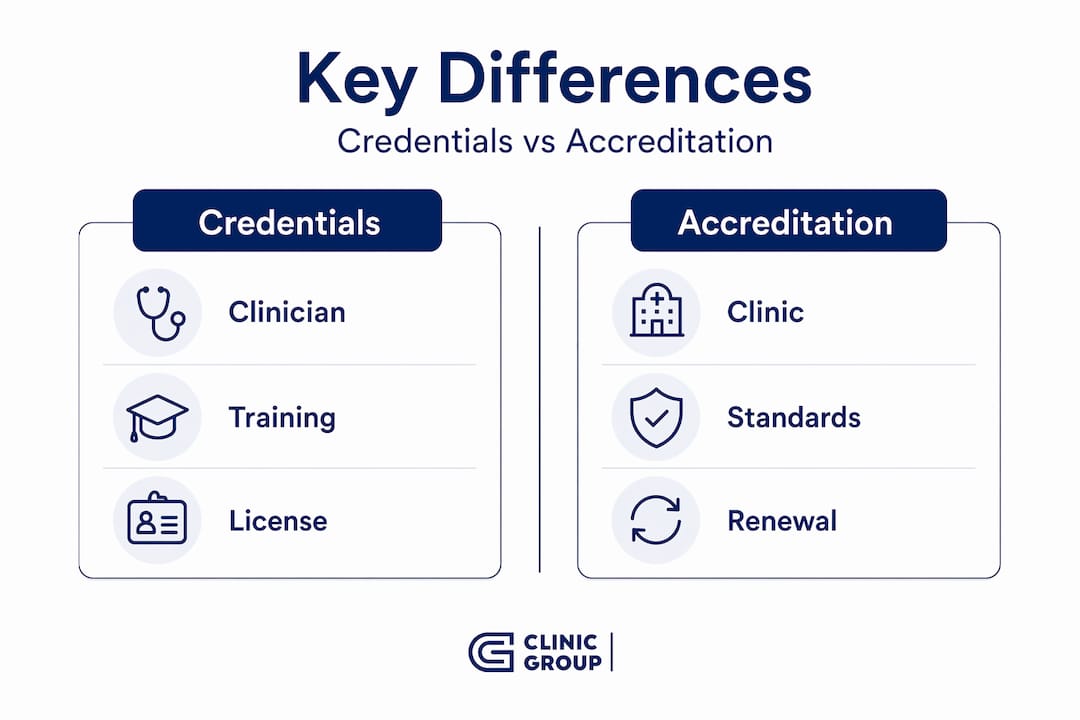
| Feature | Individual credentials | Clinic accreditation |
|---|---|---|
| What it confirms | Clinician’s training, registration, and legal authority | Facility’s processes, safety standards, and quality systems |
| Issued by | National medical councils and universities | Independent accreditation bodies |
| Renewal frequency | Periodic re-registration, often annual | Multi-year cycles, typically every two to three years |
| How to verify | National medical council public register | Accreditation body’s public directory |
| What to ask | Name, registration number, specialist title | Accreditation body name, certificate number, expiry date |
OhioHealth Vein Clinic’s three-year IAC accreditation renewal illustrates what genuine accreditation looks like in practice. The process involved submitting policies, quality metrics, and undergoing virtual site surveys, not simply renewing a certificate. This kind of rigorous cycle is what separates meaningful accreditation from a badge with no substance behind it.
For medical tourists, multi-year accreditation renewals are particularly reassuring because they confirm that a clinic has maintained its standards consistently over time, not just at a single point of inspection.
Pro Tip: Always check the date on any accreditation certificate. An accreditation awarded five years ago and never renewed tells you very little about the clinic’s current standard of care. Ask when the last audit took place and when the next review is scheduled.
When evaluating research clinics for medical travel, look for accreditation from bodies that are themselves recognised by international quality frameworks. The clinic accreditation guide from Clinicgroup provides a detailed breakdown of what to look for and how to assess the credibility of the accrediting organisation itself.
Risks of ignoring clinic credentials
The consequences of not verifying clinic credentials before travelling abroad can be serious, and in some cases, difficult to resolve once you have returned home. This is not about discouraging medical travel. It is about understanding the specific risks that arise when due diligence is bypassed.
“Credential failures rarely look like obvious fraud. More often, they are gaps in documentation, outdated licences, or practitioners operating outside their verified specialty. These gaps only become visible when something goes wrong.”
The practical risks include:
- Exposure to unqualified practitioners. Negligent credentialing occurs when a clinic fails to verify its practitioners properly. This exposes patients to clinicians who may lack the training or legal authority for the procedure performed.
- Reduced legal protection. At least 28 US states recognise negligent credentialing as a distinct cause of legal action. In international contexts, the legal routes are often more complex and less accessible to patients.
- Complications and poor outcomes. Procedures performed by practitioners without specialist training in the relevant area carry higher complication rates. Substandard sterilisation or equipment standards in non-accredited facilities add further risk.
- Aftercare gaps. Clinics without proper facility accreditation are less likely to have structured aftercare protocols in place. This matters significantly for dental implants, hair transplants, or any procedure requiring post-operative monitoring.
- Insurance and compensation issues. Many travel insurance policies require treatment to be performed by a credentialed practitioner at an accredited facility. Missing credentials can void your coverage entirely.
Robust credentialing relies on primary source verification and documented follow-up, not on a practitioner’s self-reported history. Patients who rely on clinic-provided information alone are not protected by this process.
How Clinicgroup supports verified treatment abroad
Clinicgroup was built around a straightforward principle: patients deserve access to verified, high-quality care regardless of where they choose to seek treatment. Every clinic in the Clinicgroup network is vetted against specific credentialing and accreditation standards before being listed on the platform.
For patients considering dental travel or cosmetic procedures in Albania or Dubai, this means practical reassurance at every stage of the process. The key features of Clinicgroup’s approach include:
- Board-certified specialists. Clinicians listed through Clinicgroup hold verifiable specialist qualifications relevant to the procedures they perform, not just general medical licences.
- Transparent clinic profiles. Clinic listings include accreditation information, specialist credentials, and patient reviews so you can compare clinics on substance rather than presentation alone.
- Travel and logistics support. Clinicgroup assists with travel planning, partner hotel arrangements, and transfer coordination, reducing the logistical complexity of seeking treatment abroad.
- Aftercare coordination. Credentialed clinics in the Clinicgroup network provide structured aftercare services that are outlined clearly before treatment begins.
- Direct consultation access. Patients can request consultations before committing, giving them the opportunity to ask credentialing questions directly and verify specialist details in advance.
When comparing clinic features for safe medical travel, use the Clinicgroup directory as a starting point and then independently verify the credentials of your named clinician through the relevant medical council registry.
My perspective on credential verification
I’ve worked with international patients long enough to know that the most confident travellers are not the ones who found the cheapest deal. They are the ones who asked the right questions before they booked.
What I’ve seen repeatedly is that credential failures are rarely dramatic. They are quiet. A clinician performing implants without specialist oral surgery qualifications. A clinic displaying an accreditation badge that lapsed two years ago. A website listing treatment outcomes that belong to a different practitioner entirely. None of these things are visible in a Google review.
My honest view is that patients underestimate how much power they have in this process. Asking for a clinician’s registration number is not rude or suspicious. It is entirely reasonable, and any reputable clinic will respond without hesitation. The clinics that deflect or delay that request are the ones worth questioning.
The importance of clinic credentials is not abstract. It is the difference between knowing who is treating you and simply hoping for the best. Clinicgroup was designed to make that knowledge accessible and straightforward, because safe treatment abroad should not require patients to be investigators. But doing your own verification alongside platform vetting is always worthwhile. Informed patients get better outcomes, and that is not an opinion. It is a consistent pattern.
— Clinic
Plan your treatment with confidence through Clinicgroup
Clinicgroup connects patients from the UK and across Europe with verified clinics in Albania and Dubai, covering dental implants, hair transplants, cosmetic surgery, and wellness treatments. Every clinic in the network meets defined credentialing and accreditation standards, with transparent pricing and board-certified specialists across all treatment areas.
You can browse the full range of available treatments or explore the verified clinics directory to compare accreditation details, specialist credentials, and patient reviews in one place. The Clinicgroup team handles travel logistics, partner hotel bookings, and aftercare coordination so your focus stays on making an informed choice rather than managing the process alone. Start with a no-obligation consultation to ask your credential questions directly before you commit.
FAQ
What does researching clinic credentials actually involve?
Researching clinic credentials means independently verifying that both the treating clinician and the facility hold current, valid licences, qualifications, and accreditations relevant to your specific procedure. This goes beyond reading online reviews and requires checking national medical council registries and accreditation body directories directly.
Why verify clinic credentials rather than trusting online reviews?
Online reviews can reflect patient satisfaction with service but cannot confirm whether a clinician holds the legal authority or specialist training to perform your procedure safely. Credential verification is the only reliable way to confirm clinical competence.
What are the signs of a trusted research clinic abroad?
Trusted research clinic signs include named clinicians with verifiable registration numbers, current facility accreditation from a recognised independent body, transparent pricing, and willingness to answer credentialing questions directly before you book.
How often should clinic accreditation be renewed?
Accreditation cycles typically run for two to three years and involve formal audits, quality metric reviews, and site surveys. Three-year accreditation renewals are common for established clinics, but always confirm the renewal date to make sure the accreditation is currently active.
What questions should I ask a clinic about credentials before travelling?
Ask for the full name and medical council registration number of the clinician performing your procedure, the name of the clinic’s accreditation body and the date of the most recent audit, and whether the facility holds a current government licence to operate as a medical facility in its country of registration.