How to schedule medical appointments abroad
TL;DR:
- Scheduling medical treatment abroad requires thorough preparation, documentation, and verification of clinic credentials to ensure a smooth experience. Patients must organize medical records, travel insurance, and logistics, then follow a structured process of inquiry, confirmation, and follow-up to avoid errors and delays. Clear communication, credential checks, and post-treatment planning are vital for successful international healthcare journeys.
Planning to seek medical treatment in another country is a significant decision, and knowing how to schedule medical appointments abroad correctly can make the difference between a smooth experience and a stressful one. Whether you are considering dental implants in Albania, a hair transplant in Dubai, or another procedure at a European clinic, the scheduling process involves far more than picking a date. It requires preparation, verified providers, clear communication, and a reliable support network. This guide walks you through every step, so you can approach your treatment journey with confidence.
Table of Contents
- Key takeaways
- Preparing before you book
- How to schedule medical appointments abroad
- Common challenges when scheduling overseas
- Verification and follow-up after your appointment
- My honest take on scheduling medical care abroad
- How Clinicgroup helps you book with confidence
- FAQ
Key takeaways
| Point | Details |
|---|---|
| Prepare documentation early | Gather medical records, ID, and insurance details before contacting any clinic abroad. |
| Verify clinic credentials | Confirm accreditation and practitioner licences before submitting any appointment request. |
| Use a structured booking process | Follow a step-by-step workflow with written confirmations to avoid scheduling errors. |
| Plan for language and logistics | Arrange translation support and travel logistics alongside your appointment scheduling. |
| Confirm aftercare in advance | Clarify post-treatment follow-up options before you travel, including remote consultation availability. |
Preparing before you book
The most common mistake patients make when booking medical appointments overseas is treating it like a standard GP referral. It is not. Pre-travel planning is essential, especially for patients managing chronic conditions that require specialised equipment or continuity of care.
Before you contact a single clinic, take time to build your information foundation. Here is what you need to have ready:
- A clear summary of your medical need. Whether it is cosmetic, dental, or a wellness programme, write down the treatment you are seeking, any relevant diagnoses, and your current health status.
- Full medical records in English. Many international clinics require translated documentation. Complete medical records and translated documents are foundational to avoiding scheduling errors and complications.
- Current medication list. Include dosages and generic names, as brand names differ across countries.
- Valid travel insurance with medical cover. Not all travel insurance policies cover planned medical procedures, so read the small print carefully and obtain a policy that does.
- Visa and entry requirements. Some treatments require extended stays, and visa conditions may affect how long you can remain in the destination country.
- Language support plan. If the clinic operates in a different language, identify whether they offer in-house interpreters or whether you will need to arrange your own.
Useful tools for organising your medical travel include Doctolib for scheduling in France, and the Allyz app by Allianz, which allows travellers to book Global Doctor Visits in person or via telehealth, with the first three consultations potentially free of charge. For those who cannot attend in person immediately, telemedicine is worth considering as a complement to your trip. It allows an initial remote consultation before you commit to travel.
Pro Tip: Request a digital copy of all your documents and store them in a cloud folder you can access from any device. Share access with a trusted contact at home in case you need records retrieved in an emergency.
| Preparation item | Why it matters |
|---|---|
| English-language medical records | Required by most international clinics for accurate assessment |
| Travel insurance with medical cover | Protects you financially if treatment is delayed or complications arise |
| Medication list with generic names | Avoids dispensing errors in countries using different brand names |
| Translated documents | Reduces miscommunication with clinical and administrative staff |
| Visa and stay duration check | Prevents legal complications if recovery extends beyond expected timeframe |
How to schedule medical appointments abroad
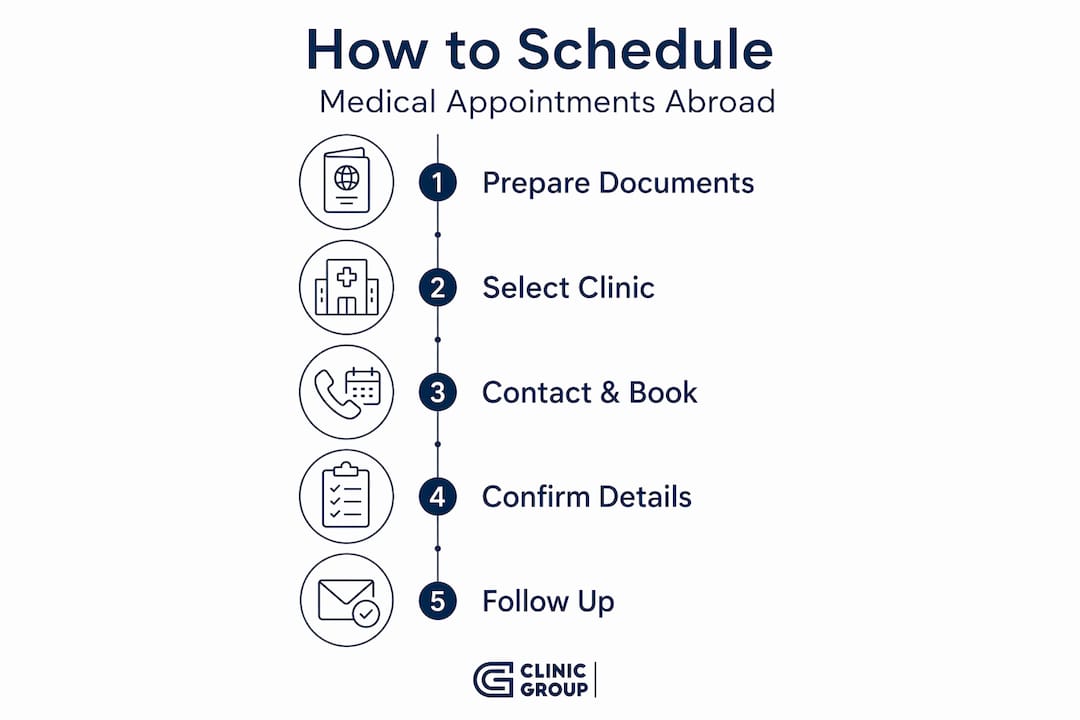
Once your preparation is complete, the actual process of international healthcare scheduling follows a logical sequence. Following it in order reduces the risk of errors and gives you written records at every stage.
-
Identify clinics that match your treatment type. Use a verified platform or directory to find clinics with demonstrable experience in your specific procedure. The International Society of Travel Medicine lists healthcare professionals across more than 80 countries, and platforms like Clinicgroup allow you to compare verified clinics by treatment, location, and accreditation.
-
Submit a formal appointment request. Most reputable international patient services request a written enquiry form or email. Services such as those offered by Mayo Clinic’s International Patient team provide a fully coordinated process from initial enquiry to return home, reducing patient stress significantly. Submit your name, nationality, treatment required, preferred dates, and any relevant clinical documents.
-
Provide all requested documentation promptly. Delays in submitting records are the single most common cause of postponed appointments. Send your medical history, identification, and insurance details as soon as they are requested.
-
Receive and verify your appointment confirmation. A reliable clinic will send written confirmation by email detailing the date, time, treating clinician, location, and any pre-appointment instructions. Structured appointment workflows with follow-up contact and language support are a hallmark of reputable international patient services.
-
Confirm logistics alongside the appointment. Book your flights and accommodation with enough flexibility to accommodate possible scheduling adjustments. Many patients underestimate how much a delayed surgery or an extra recovery day can affect travel plans.
-
Follow up in writing before you travel. Send a brief email two to three days before your appointment to reconfirm the booking. Ask specifically whether anything further is required from you.
Pro Tip: Always communicate with the clinic via email rather than phone where possible. Written records protect both you and the clinic if any misunderstanding arises about appointment times, costs, or clinical expectations.
Common challenges when scheduling overseas
Even well-prepared patients encounter obstacles when arranging healthcare appointments in foreign countries. Knowing what to expect reduces panic and allows you to solve problems quickly.

Language barriers are the most frequently cited issue. Beyond translation apps, which are useful but imperfect, look for clinics that provide dedicated patient coordinators who speak your language. This is a standard offering at established international patient centres and should be a non-negotiable when comparing providers.
Differences in healthcare administration can also catch patients off guard. Appointment confirmation timelines, pre-payment requirements, and cancellation policies vary significantly from country to country. What feels like a slow response from a clinic in Albania or Turkey may simply be a different administrative rhythm. Build in an extra week of lead time when scheduling overseas to absorb these differences.
Appointment cancellations and rescheduling do happen, particularly in clinics that serve both local and international patients. If your appointment is moved, clarify immediately whether your travel dates still align. Ongoing treatments require advance fixed bookings at facilities with the right equipment. Last-minute rescheduling for specialist procedures can fail due to staffing or equipment constraints. Build flexibility into your itinerary.
If you encounter a serious problem and cannot access clinic support, your nearest embassy or consulate is a reliable back-up. Consular emergency services operate around the clock and can assist in locating medical providers, contacting family, or coordinating care in urgent situations.
When it comes to verifying credentials, do not rely solely on a clinic’s own website. Cross-reference any clinic against national medical boards, look for international accreditation bodies such as JCI (Joint Commission International), and read third-party patient reviews. The Clinicgroup clinic accreditation guide provides a clear framework for doing this confidently.
Verification and follow-up after your appointment
Scheduling the appointment is only part of the process. What happens after your medical visit abroad matters just as much to your overall wellbeing and to the continuity of your care back home.
Here is what to address before you leave the clinic and before you leave the country:
- Obtain all official records and documentation. Request a written summary of the consultation or procedure, any imaging or test results, and the treating clinician’s name and contact details. These are essential for your home-country GP or specialist.
- Clarify the total cost and payment procedures. Understand what is included in the quoted price and what is not. Ask about payment methods accepted and whether receipts are provided in a format your insurer will accept.
- Agree on an aftercare plan. Whether your recovery requires a return visit, remote follow-up, or a handover to your home GP, this should be confirmed in writing before you travel back.
- Use available aftercare resources. Platforms like Clinicgroup include aftercare support as part of their service. This matters more than many patients realise, particularly for surgical procedures where complications may appear days or weeks after the initial treatment.
- Keep copies of everything. Store physical and digital copies of all clinical documents, receipts, and correspondence. Your home-country doctor will need these to continue your care without gaps.
Pro Tip: Before your appointment, ask the clinic directly: “How do you handle follow-up queries from international patients after they return home?” A clinic that has a clear, structured answer is one you can trust.
| Post-appointment task | Action required |
|---|---|
| Clinical documentation | Request written records, test results, and clinician details |
| Payment receipts | Obtain insurer-compatible receipts for all costs paid |
| Aftercare plan | Confirm remote follow-up or home-country GP handover in writing |
| Medication instructions | Get written guidance, preferably in English, for any new prescriptions |
| Review submission | Share your experience on the booking platform to help future patients |
My honest take on scheduling medical care abroad
I have worked with patients at various stages of their international treatment planning, and the pattern I see most often is this: people invest weeks researching the procedure itself but then rush through the scheduling. They assume that if the clinic looks credible and the price is right, the logistics will sort themselves out. They rarely do.
What I have found is that the scheduling process abroad is where a patient’s experience is often made or broken. A clinic that responds within 24 hours, asks for the right documents upfront, and sends a detailed appointment confirmation is telling you something about how it will treat you as a patient. A clinic that is vague about costs, slow to confirm, or dismissive of follow-up questions is also telling you something.
The other thing I will say plainly: scheduling recurring treatments abroad requires treating each trip as a logistics project with fixed bookings, not a flexible arrangement. I have seen patients lose deposits, miss treatment windows, and face real health setbacks because they assumed flexibility that was never on offer. Plan precisely. Confirm everything in writing. And if a clinic cannot tell you clearly what happens after your appointment, find one that can.
— Clinic
How Clinicgroup helps you book with confidence
Clinicgroup takes the complexity out of arranging healthcare appointments in foreign countries. Through its verified network of clinics in Albania and Dubai, patients from the UK and across Europe can access a full range of treatments including dental care, hair transplants, plastic surgery, non-surgical aesthetics, and wellness programmes. Every clinic in the network is checked for accreditation and quality standards, and patient coordinators are available to manage appointment scheduling, travel logistics, and partner hotel arrangements from a single point of contact. Pricing is transparent, aftercare is structured, and patients are supported at every stage. If you are ready to take the next step, explore the Clinicgroup treatment options and submit your enquiry today.
FAQ
What documents do I need to schedule a medical appointment abroad?
You will typically need your medical records in English, a valid form of identification, proof of travel insurance, and a written summary of your treatment requirements. Translated documents and complete records reduce administrative delays and help clinicians assess your case accurately.
How far in advance should I book a medical appointment overseas?
Most specialists recommend booking at least four to eight weeks in advance for planned procedures, and earlier for complex or specialist treatments. Last-minute scheduling for procedures requiring specialist equipment or staffing can result in cancellations or delays.
How do I verify that a clinic abroad is safe and accredited?
Check for international accreditation such as JCI, review the clinic on third-party platforms, and consult a safe medical travel guide that outlines the key quality indicators to look for in overseas clinics.
What should I do if my appointment abroad is cancelled or rescheduled?
Contact the clinic immediately in writing to clarify new dates and confirm whether your travel arrangements still align. If you cannot reach the clinic, consular emergency services can assist in locating alternative medical support or emergency contacts.
Can I use telemedicine to complement my medical appointments abroad?
Yes. Telemedicine is an effective option for initial consultations or post-treatment follow-up. It requires prior setup and attention to time zone differences, but telemedicine as a supplement to in-person care is increasingly standard among international patient services.