Why opt for same-day dentistry: a patient’s guide
TL;DR:
- Same-day dentistry uses in-office CAD/CAM technology to design, mill, and fit permanent crowns within a single appointment. It eliminates temporary crowns, reduces time, and offers advantages like improved accuracy and patient comfort, especially in emergencies. However, individual cases require clinical assessment to determine suitability for this efficient treatment approach.
Dental pain rarely arrives at a convenient time. A cracked crown on a Friday afternoon, a broken tooth before a work trip — these situations leave many people dreading a drawn-out cycle of temporary fixes and return appointments. Understanding why opt for same-day dentistry is genuinely useful right now, because the technology has matured to the point where a single visit can deliver a permanent, precision-made restoration. This article explains how same-day dentistry works, who it suits, and why it may be the most efficient dental decision you make.
Table of Contents
- Key takeaways
- How same-day dentistry actually works
- Clinical benefits beyond just speed
- Urgent care: when timing changes outcomes
- When same-day dentistry may not be the right fit
- My perspective on same-day dentistry
- Access same-day dental care through Clinicgroup
- FAQ
Key takeaways
| Point | Details |
|---|---|
| Single-visit restorations are real | CAD/CAM technology allows permanent crowns and restorations to be designed, milled, and fitted in one appointment. |
| No temporary crowns needed | Patients avoid the discomfort and failure risk of temporary crowns entirely, leaving with a finished result the same day. |
| Urgent cases benefit most | Prompt treatment after dental trauma directly improves the chances of saving a damaged tooth. |
| Not every case qualifies | Complex bite or structural issues may still require a conventional multi-visit pathway; a clinical assessment confirms suitability. |
| Abroad options offer strong value | Verified clinics in Albania and Dubai offer same-day dentistry at significantly lower cost than equivalent UK treatments. |
How same-day dentistry actually works
The phrase “same-day dentistry” sounds like marketing, but the process behind it is grounded in well-established digital technology. At its centre is CAD/CAM technology, which stands for computer-aided design and computer-aided manufacturing. Rather than sending impressions to an external laboratory and waiting one to three weeks, the entire workflow happens chairside.
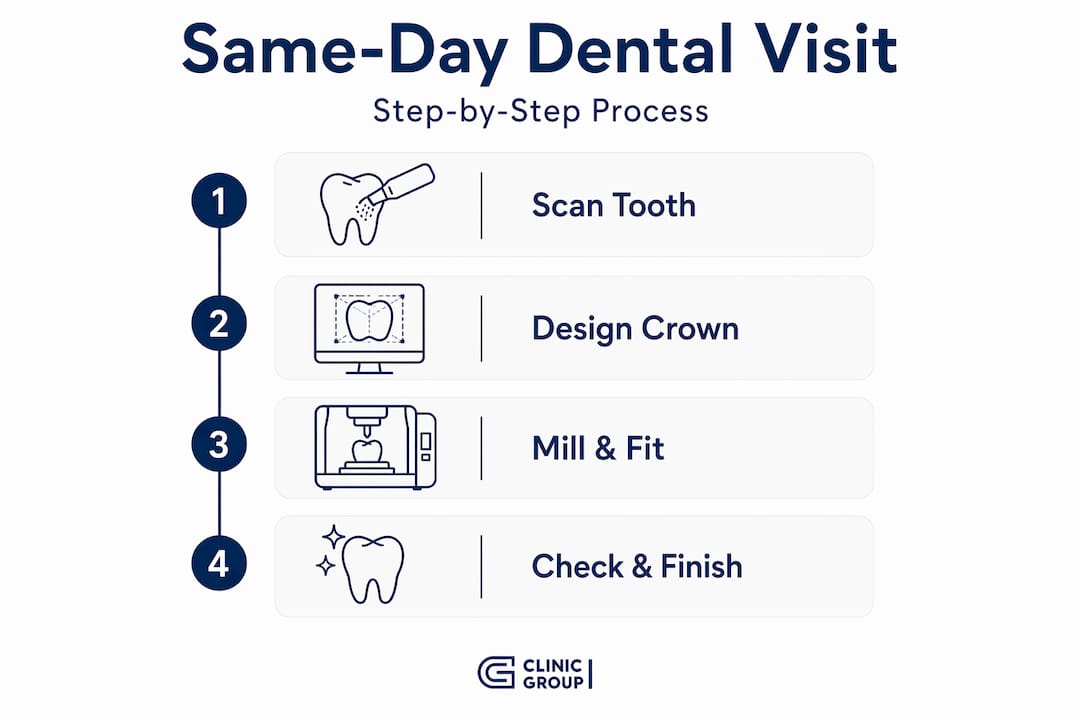
Here is how a typical same-day crown appointment unfolds:
- Digital scan: A small intraoral wand scans your tooth and creates a highly accurate 3D model in seconds. Digital scans replace the goopy physical molds that trigger gag reflexes and cause patient anxiety.
- On-screen design: The dentist uses specialist software to design the crown directly on a screen, adjusting the shape, contours, and bite contact in real time.
- In-office milling: A chairside milling machine carves the restoration from a ceramic block, typically within 15 to 20 minutes.
- Fitting and adjustment: The crown is checked, polished, and bonded. Any margin issues are identified and corrected during the same visit, without the need for lab remakes or return trips.
The contrast with a traditional pathway is significant. Conventional crown treatment requires tooth preparation on day one, a temporary crown fitted the same day, and a return visit two to three weeks later once the laboratory has fabricated the final restoration. The same-day crown appointment typically takes 60 to 120 minutes from start to finish, with a permanent result in your mouth before you leave.
Pro Tip: Ask your clinic specifically whether they use in-house milling or send CAD/CAM designs to an off-site laboratory. True same-day treatment requires on-site milling equipment. Some clinics design digitally but still rely on external labs, which means a second appointment.
The digital workflow also compresses scheduling pressures considerably. There is no coordination required between the dental practice and an external lab, no rescheduling if the lab delivery is delayed, and no temporary crown to manage between visits.
Clinical benefits beyond just speed
Speed is the headline, but the clinical advantages of same-day dentistry go further than saving time. For patients exploring this option, it helps to understand exactly what you gain beyond a faster appointment.
The removal of the temporary crown phase is arguably the most underappreciated benefit. Temporary crowns are designed to be short-term solutions and carry real risks. They can debond, fracture, or allow bacterial ingress into the prepared tooth. Avoiding temporaries entirely eliminates those failure risks and removes the discomfort some patients experience between appointments.
The material used in same-day restorations also deserves attention. Modern CAD/CAM ceramic blocks produce colour-matched ceramic crowns that are strong, natural-looking, and metal-free. Ceramic biomimetically matches the stiffness of natural enamel, which means the restoration flexes in a similar way to your surrounding teeth, reducing stress on the prepared tooth structure.
Consider these additional clinical advantages:
- More conservative preparation: Because the digital scan captures fine detail, dentists can often preserve more healthy enamel compared to traditional crown preparation techniques.
- Improved accuracy: Fit issues can be spotted and corrected on the spot rather than discovered at a second appointment after a lab remake.
- Better patient experience for anxious individuals: Same-day treatment reduces the number of injections, preparation sessions, and return visits, which is a meaningful comfort improvement for patients with dental anxiety.
- Practical for busy schedules: A single two-hour appointment is easier to arrange than two separate visits weeks apart, particularly for patients travelling for treatment.
Patients managing dental anxiety will find same-day pathways genuinely easier to tolerate, both psychologically and physically, compared to a traditional multi-visit schedule.
“For many patients, the prospect of sitting through a single longer appointment is far preferable to the stress of returning for multiple visits, especially when each visit involves additional anaesthetic and preparation.”
Urgent care: when timing changes outcomes
The same-day dental care advantages are most clinically critical in emergency situations. Dental trauma — a knocked-out tooth, a fractured root, severe decay exposing the nerve — is not just painful. It is time-sensitive in a biological sense.
April 2026 AAE guidelines from the American Association of Endodontists reinforce that timely diagnosis and treatment after dental trauma directly improves the chances of preserving the injured tooth. The guidelines make clear that prompt care is not simply about pain relief. It is about biological preservation.
For avulsed (knocked-out) teeth, the research is stark. Extraoral dry time beyond 60 minutes significantly increases the risk of root resorption and ankylosis, both of which threaten the long-term survival of the tooth. Every hour without appropriate intervention reduces the likelihood of a successful outcome.
Same-day dentistry fits directly into this picture. A clinic equipped for immediate digital assessment and chairside fabrication can move from diagnosis to treatment within a single appointment, rather than asking a patient in pain to return days later. For fractures and damaged crowns, an immediate permanent restoration protects the tooth from further bacterial exposure and sensitivity.
Patients who are travelling abroad and experience dental trauma benefit particularly from this model. Being told that treatment will require multiple visits over several weeks is simply not practical when you are away from home. The convenience of same-day dental visits is not just comfort in this context. It is clinically and logistically essential.
When same-day dentistry may not be the right fit
A balanced view on this topic requires addressing cases where same-day treatment is not appropriate. The convenience of quick dental procedures should not lead patients or clinicians to force an unsuitable case through a single-visit pathway.
Here are the situations where a conventional multi-visit approach is more likely to deliver better outcomes:
- Complex occlusal issues: If your bite requires significant adjustment or analysis across multiple appointments, rushing to a same-day restoration risks producing a crown that does not sit correctly in your bite.
- Extensive structural damage: Teeth with severe structural compromise may need staged treatment, including core build-ups or post and core placements, before a crown can be fabricated.
- Active infection: If there is an unresolved abscess or active infection, placing a permanent restoration over an untreated tooth is clinically inappropriate. The infection must be addressed first.
- Full-arch restorative cases: Treatment involving multiple crowns, implants, or significant bite reconstruction typically requires laboratory-fabricated restorations for optimal aesthetics and function.
The key principle is individualised assessment. Case selection directly determines the success of same-day workflows. A thorough clinical examination, including digital imaging where indicated, tells your dentist whether your situation suits single-visit treatment.
Pro Tip: Before any same-day appointment, ask your dentist to confirm that your case has been assessed specifically for this pathway. A reliable clinic will never push same-day treatment when conventional phased care serves you better clinically.
Managing your expectations around appointment length also matters. Same-day dentistry is not a ten-minute visit. A full crown appointment runs between 60 and 120 minutes, with part of that time spent waiting for the milling machine to complete fabrication. Plan your schedule accordingly.
My perspective on same-day dentistry
In my experience working with patients across our verified clinic network, the shift in patient satisfaction when they experience same-day dentistry for the first time is clear and consistent. Patients who have previously gone through the traditional pathway — the temporary crown, the wait, the second injection at a return visit — are often genuinely surprised by how much simpler the process feels.
What I find particularly compelling is the confidence it gives anxious patients. When someone dreads dental care, removing half the appointments removes half the dread. That is not a trivial improvement. It is the difference between a patient who follows through with treatment and one who avoids it until the situation becomes more serious.
I also think the digital dentistry advantages are still underestimated by patients who have not yet experienced them. The accuracy of a chairside digital scan, the ability to correct margins on the spot, and the quality of modern ceramic materials combine to produce restorations that are genuinely excellent. Is same-day dentistry worth it? For the right case, absolutely. The clinical outcomes are strong, the patient experience is markedly better, and for those travelling for treatment, the single-visit model is often the only practical option.
My view is that patients should ask about same-day options proactively rather than assuming the traditional pathway is standard. The technology is widely available at high-quality clinics abroad, and the cost savings compared to UK prices make it worth exploring seriously.
— Clinic
Access same-day dental care through Clinicgroup
Clinicgroup connects patients with verified clinics in Albania and Dubai that offer advanced same-day dental treatments, including crowns, veneers, and restorative care using in-house CAD/CAM technology. Every clinic in our network has been assessed for safety standards, equipment quality, and clinical expertise. You can explore available treatments and compare options directly on the platform. For patients travelling from the UK or Europe, Clinicgroup provides support with clinic matching, appointment scheduling, partner hotels, and aftercare. Pricing is transparent, and costs are significantly lower than equivalent private dentistry in the UK. If you are considering dental care abroad, our clinic directory makes it straightforward to find trusted providers offering the fast, high-quality treatment you need.
FAQ
What is same-day dentistry?
Same-day dentistry uses chairside CAD/CAM technology to design, mill, and fit a permanent dental restoration such as a crown within a single appointment, typically lasting 60 to 120 minutes.
Is same-day dentistry suitable for emergencies?
Yes. For urgent cases such as fractured or damaged teeth, prompt treatment improves clinical outcomes. Same-day dentistry allows immediate diagnosis and permanent restoration within one visit.
Are same-day crowns as durable as traditional ones?
Same-day crowns are made from high-strength, colour-matched ceramic that is both durable and aesthetically natural. They are fabricated to the same clinical standards as laboratory-made crowns when appropriate case selection is applied.
Does same-day dentistry work for everyone?
Not every patient is a suitable candidate. Complex cases involving bite issues, active infection, or extensive structural damage may require a conventional multi-visit approach. A clinical assessment confirms suitability.
Can I access same-day dentistry abroad?
Yes. Many verified clinics in destinations such as Albania and Dubai offer in-house CAD/CAM same-day treatment. Clinicgroup helps patients find and book dental care abroad with full support for travel, accommodation, and aftercare.