What is all-inclusive healthcare: a clear guide
TL;DR:
- All-inclusive healthcare varies greatly across models, from universal coverage to specialist programs and medical tourism packages.
- Patients must carefully verify what services are included, excluded, and how complications are managed to ensure true coverage and safety.
Most people hear “all-inclusive healthcare” and picture a single payment that covers everything from a GP visit to a complex surgery. The reality is considerably more nuanced. Understanding what is all-inclusive healthcare requires looking at three distinct contexts: universal health coverage as a global policy goal, specialist care programmes such as the Programme of All-Inclusive Care for the Elderly (PACE), and the bundled medical tourism packages increasingly marketed to patients across the UK and Europe. Each model works differently, serves different populations, and carries its own set of benefits and limitations.
Table of Contents
- Key takeaways
- What is all-inclusive healthcare: the universal model
- The PACE model: all-inclusive elderly care
- All-inclusive medical tourism packages
- Comparing the three all-inclusive models
- Choosing the right all-inclusive option
- My perspective on all-inclusive healthcare
- Plan your treatment with Clinicgroup
- FAQ
Key takeaways
| Point | Details |
|---|---|
| Three distinct models exist | All-inclusive healthcare spans universal coverage, specialist elderly care programmes, and medical tourism packages. |
| Financial protection is central | Genuine all-inclusive healthcare prevents financial hardship, not just bundles services under one price. |
| PACE delivers coordinated elderly care | The PACE model keeps over 90% of participants living in their communities rather than nursing homes. |
| Medical tourism packages have exclusions | Many bundled packages exclude flights, complications, and post-operative emergency care. |
| Due diligence protects patients | Verifying accreditation, requesting itemised costs, and planning for complications are non-negotiable steps. |
What is all-inclusive healthcare: the universal model
The broadest definition comes directly from the World Health Organisation. UHC covers the full continuum of care, spanning health promotion, disease prevention, treatment, rehabilitation, and palliative care. The goal is straightforward: every person receives the health services they need without suffering financial hardship as a result.
This is where most people’s understanding of “all-inclusive” begins, and it is also where the concept carries its greatest weight. Universal health coverage is not simply about ticking a list of services. It is about building equitable, efficient health systems in which care quality does not depend on your postcode, income, or social background. Primary health care acts as the backbone of this model, ensuring that most needs are addressed before they escalate into expensive, complex conditions.
Financial risk protection is arguably the defining feature of true universal health coverage. The WHO is explicit on this point: all-inclusive healthcare must prevent people from being pushed into poverty because of medical bills. That framing reshapes the conversation entirely. It means that comprehensiveness is as much a financial concept as it is a clinical one.
From a practical standpoint, comprehensive healthcare explained through the UHC lens includes:
- Health promotion and prevention: vaccination programmes, public health education, and screening initiatives
- Primary and outpatient care: GP consultations, diagnostics, and prescribed medicines
- Specialist and inpatient treatment: surgery, oncology, cardiology, and mental health services
- Rehabilitation: physiotherapy, occupational therapy, and recovery support following illness or injury
- Palliative and end-of-life care: dignity-focused support for those with life-limiting conditions
Countries implement this vision in very different ways, from single-payer national systems to mixed public-private models. What unites them is the ambition to leave no patient without recourse because of cost.
The PACE model: all-inclusive elderly care
If universal health coverage is the macro-level expression of all-inclusive care, the Programme of All-Inclusive Care for the Elderly (PACE) is one of the most concrete and contractual examples of how it works in practice. Operating primarily in the United States, PACE is a government-funded programme targeting adults aged 55 and over who meet nursing-home-level care criteria but wish to remain living in their communities.
What makes PACE genuinely all-inclusive is the scope of its delivery. An interdisciplinary care team coordinates everything a participant might need, including:
- Primary care and specialist medical visits
- Nursing and pharmacy services
- Physiotherapy, occupational therapy, and speech therapy
- Nutritional counselling and social support
- Transport to the PACE day centre
- Home care and, where required, hospital or nursing facility care
PACE uses a capitated payment system in which providers receive a fixed monthly amount per participant, regardless of the services used. This structure incentivises prevention. The less a participant is hospitalised, the more financially sustainable the programme becomes. The result is a model strongly motivated to keep patients healthy, mobile, and out of expensive acute care settings.
The outcomes speak for themselves. Over 90% of PACE participants continue living in their communities despite having complex health needs, with measurable improvements in functional status, hospitalisation rates, and social interaction. For families weighing up nursing home placement against supported community living, those figures matter.
There is one trade-off worth understanding clearly. PACE’s coordinated model requires that participants access nearly all services through the programme’s own care network. That restricts personal choice of provider. For some patients, having everything managed through a single coordinated team feels reassuring. For others, it feels limiting.
Pro Tip: If you or a family member are exploring PACE eligibility, ask the programme coordinator for a full written list of included services and confirm exactly which providers you would be required to use. Knowing this upfront prevents surprises later.
All-inclusive medical tourism packages
The third context, and the one most relevant to patients in the UK and across Europe, is the all-inclusive medical tourism package. Bundled packages covering elective procedures such as dental implants, hair transplants, cosmetic surgery, or orthopaedic treatment are now widely marketed online, often with headline prices that appear to cover everything.

Understanding what is an all-inclusive medical package in this context requires a careful read of the details. Many packages do include the procedure itself, pre-operative assessments, accommodation, airport transfers, and some aftercare. That is genuinely valuable. But the word “all-inclusive” has limits that patients frequently discover only after booking.
The CDC advises patients to ask the following before committing to any medical tourism package:
- What is explicitly included? Request a written, itemised breakdown of every service covered by the quoted price.
- What is excluded? International flights, travel insurance, and complications arising after returning home are commonly left out.
- What happens if something goes wrong? Confirm in writing what care the overseas clinic will provide if a complication develops, and whether that care is covered within the package price.
- Is my domestic healthcare provider informed? Your GP or specialist at home should know you are having a procedure abroad so they can support your recovery and manage any complications on return.
- What insurance is in place? Verify that the clinic holds appropriate professional liability cover and that your own travel insurance includes medical repatriation.
The risk of unexpected costs is real. Patients who experience post-operative complications abroad may face bills for additional hospital stays, revision procedures, or emergency evacuation that fall entirely outside the original package price.
Pro Tip: Before travelling abroad for treatment, request a dental health travel checklist from your chosen clinic or use a dedicated resource to confirm you have covered every practical and medical consideration before you fly.
Knowing these risks does not mean avoiding medical tourism. It means approaching it as an informed patient rather than a price-driven consumer. Many clinics operating internationally maintain standards that equal or exceed what patients would experience at home, but due diligence separates the reliable providers from the rest.
Comparing the three all-inclusive models
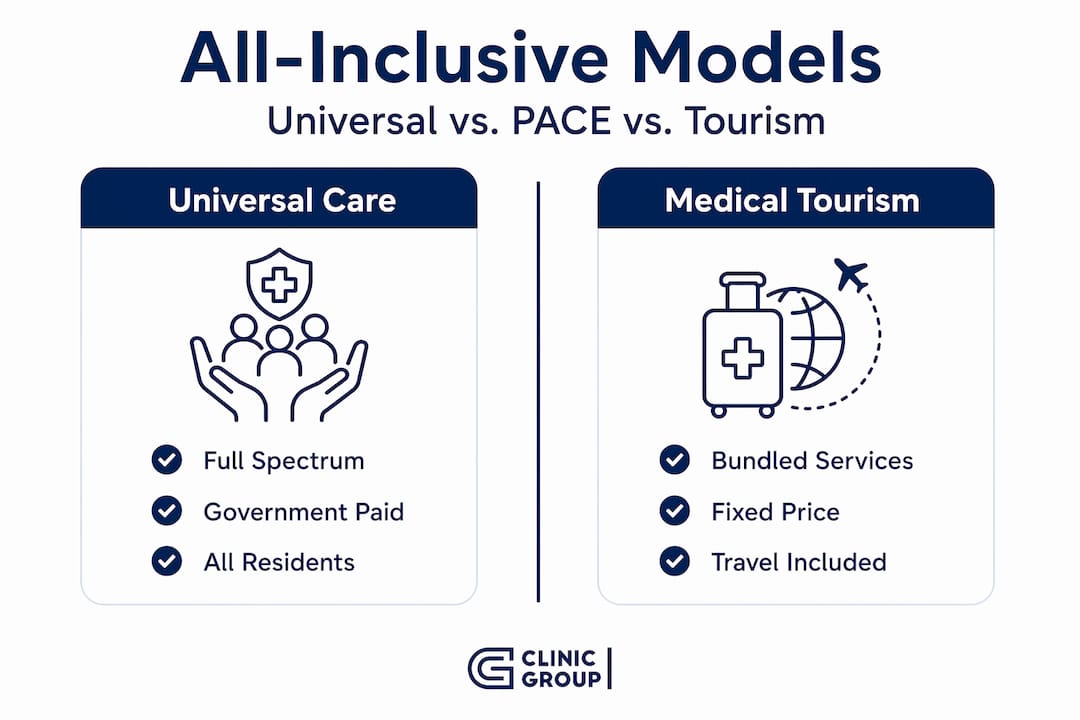
Patients researching all-inclusive healthcare options often find themselves confused by how differently the term is applied across these three contexts. The comparison below clarifies the key distinctions.
| Feature | Universal health coverage | PACE programme | Medical tourism packages |
|---|---|---|---|
| Scope of care | Full continuum, lifelong | Complex elderly needs, ongoing | Single procedure or episode |
| Funding mechanism | Government/public systems | Capitated Medicare/Medicaid | Out-of-pocket patient payment |
| Eligibility | All citizens/residents | Age 55+, nursing-home criteria | Any paying patient |
| Care coordination | System-wide, variable | Mandatory interdisciplinary team | Clinic-dependent, variable |
| Financial protection | Central goal | Built into capitated model | Not guaranteed, exclusions common |
| Patient choice | Varies by country | Limited to PACE network | Wide choice of destinations |
The practical lesson here is that “all-inclusive” does not mean the same thing across these models. For patients considering international treatment, the medical tourism column is the most directly relevant. It is also the model where patient responsibility is highest, because the protections built into UHC and PACE do not automatically apply.
Choosing the right all-inclusive option
Whether you are researching types of comprehensive health plans for long-term care or evaluating a specific overseas treatment package, the criteria for making a good decision follow the same logic.
Accreditation and specialist credentials are non-negotiable. Look for clinics accredited by internationally recognised bodies and confirm that the specialists who will treat you hold verified board certification. Platforms such as Clinicgroup compare clinic features systematically, which removes much of the uncertainty from this process.
Transparent pricing is the clearest signal of a trustworthy provider. A reputable clinic will give you a written breakdown of costs before you commit. If a quote is vague or resists itemisation, that is a warning sign.
For medical tourism specifically, there are several additional points worth confirming before you travel:
- Request written documentation of the clinic’s complication management protocol
- Confirm that aftercare for medical tourists is included or clearly priced separately
- Check whether the clinic has experience treating patients from your home country, as this often correlates with smoother communication and logistical support
- Verify that follow-up consultations, whether remote or in-person, are available after you return home
Pro Tip: Ask your prospective overseas clinic to connect you with a previous patient from the UK or your home country who had the same procedure. A genuine clinic will not hesitate to facilitate this, and the first-hand account will tell you more than any brochure.
My perspective on all-inclusive healthcare
From my experience working with patients navigating international treatment options, the biggest misconception about all-inclusive healthcare is that more coordination automatically means more convenience. In specialised programmes like PACE, that coordination delivers real results. But in medical tourism, the term is often used as a marketing device more than a structural guarantee.
What I have observed is that patients who do well with all-inclusive medical packages abroad are not those who simply trust the headline price. They are the ones who ask difficult questions, read every clause, and plan for the possibility of complications before they land. The patients who struggle are often those who interpreted “all-inclusive” to mean “nothing can go wrong.”
I have also seen that cost savings abroad are genuine and significant for many treatments, particularly dentistry, hair restoration, and elective cosmetic procedures. The savings are real. The risks are manageable. But managing them requires preparation that goes beyond booking a flight and trusting a brochure.
The is all-inclusive healthcare worth it question rarely has a simple answer. For the right patient, the right procedure, and the right clinic, it absolutely can be. Getting to that certainty takes work upfront. That investment of time is where the real value lies.
— Clinic
Plan your treatment with Clinicgroup
Clinicgroup connects patients across the UK and Europe with verified clinics offering transparent, well-structured treatment packages in Albania and Dubai. Every clinic in the network is assessed for accreditation, specialist credentials, and patient support services before being listed. Whether you are exploring dentistry, hair transplants, cosmetic surgery, or wellness treatments, the platform provides detailed treatment information alongside genuine pricing, so you understand exactly what is and is not included before you book.
Support does not end at the clinic door. Clinicgroup assists with travel logistics, partner hotel arrangements, and post-treatment aftercare planning, making the full experience as straightforward as possible. You can also browse the verified clinics directory to compare providers by treatment type, location, and patient reviews. If you are ready to take the next step, request a free consultation and let the team help you match your needs to a provider you can trust.
FAQ
What does all-inclusive healthcare actually cover?
All-inclusive healthcare covers the full range of services relevant to a patient’s needs, from prevention and diagnosis to treatment, rehabilitation, and follow-up care. The exact scope depends on the model, whether that is universal health coverage, a specialist programme like PACE, or a medical tourism package.
Is all-inclusive healthcare worth it for elective treatment abroad?
For many patients, bundled medical packages abroad offer genuine cost savings alongside quality care. The key is verifying what the package includes, confirming complication coverage, and choosing a clinic with transparent pricing and verified specialists.
What is typically excluded from all-inclusive medical tourism packages?
Medical tourism packages commonly exclude international flights, travel insurance, costs related to post-operative complications, and follow-up care after returning home. Always request a written, itemised cost breakdown before booking.
How does PACE differ from standard health insurance?
PACE is a capitated care programme that coordinates all medical and social services through a single interdisciplinary team, rather than reimbursing individual providers separately. Participants must receive most care through the PACE network, which enhances coordination but limits provider choice.
What should I ask before booking an all-inclusive healthcare package abroad?
Ask for a written itemised cost list, confirmation of what happens if complications arise, details of navigating consultations abroad safely, and verification of the clinic’s accreditation and specialist credentials.