TL;DR:
- Quality assurance in healthcare proactively prevents errors and ensures safe, consistent patient care.
- Effective programs depend on strong leadership, staff training, continuous audits, and technological integration to succeed.
Quality assurance is one of the most misunderstood concepts in healthcare. Many clinic administrators still treat it as a compliance exercise, something to prepare for inspections and then set aside. In reality, the role of quality assurance in clinics is far more consequential. It determines whether patients receive safe, consistent, and effective care every single time they walk through the door. For healthcare professionals looking to raise standards, reduce errors, and build lasting patient trust, understanding how quality assurance works in practice is not optional. It is the foundation on which reliable clinical care is built.
Table of Contents
- Key takeaways
- What quality assurance in healthcare actually means
- How QA directly shapes patient outcomes
- Best practices for implementing QA in your clinic
- Emerging technologies shaping clinic QA
- My perspective on getting QA right
- How Clinicgroup supports quality in every patient journey
- FAQ
Key takeaways
| Point | Details |
|---|---|
| QA is proactive, not reactive | Quality assurance prevents errors before they occur, rather than identifying them after the fact. |
| Strong leadership drives QA success | Sustainable quality programmes require committed leadership and full staff engagement at every level. |
| Technology amplifies QA outcomes | Automation and AI tools reduce manual errors, save time, and support faster clinical decisions. |
| QA directly improves patient safety | Structured QA frameworks reduce medical errors, infections, and adverse events across clinical settings. |
| Documentation is a safety net | Recording the rationale behind QA decisions protects clinics during leadership changes and inspections. |
What quality assurance in healthcare actually means
There is a persistent confusion between quality assurance, quality control, and quality improvement. These are related but distinct concepts, and mixing them up leads to poorly structured programmes that leave gaps in patient safety.
Quality assurance structures processes to prevent errors before they occur. It operates at the system level, setting standards, defining protocols, and creating the conditions under which good clinical care becomes the default rather than the exception. Quality control, by contrast, is reactive. It identifies problems after they have already happened, whether that is a missed diagnosis, a contaminated instrument, or an inconsistent medication dose.
Quality improvement sits above both. It uses data gathered from QA and QC activities to make lasting changes to clinical workflows, staff training, and service delivery over time.
Understanding these distinctions matters because many clinics invest heavily in quality control while neglecting the upstream work of quality assurance. They catch problems but never stop them from occurring in the first place. A well-designed quality management system in a clinic integrates all three, with QA forming the preventive backbone.
Key concepts to understand when building a QA foundation include:
- Quality assurance (QA): Proactive process design that prevents clinical errors and maintains standards consistently.
- Quality control (QC): Reactive identification of errors or deficiencies after they have occurred.
- Quality improvement (QI): Ongoing analysis and refinement of systems to achieve better outcomes over time.
- Quality management system (QMS): The overarching framework that integrates QA, QC, and QI into a unified operational structure.
- Accreditation benchmarks: External standards such as those set by the NCQA, which oversees quality for over 236 million health plan enrollees and certifies more than 11,000 healthcare entities globally.
Getting these definitions right is the starting point for any clinic serious about delivering safe and consistent care.
How QA directly shapes patient outcomes
The impact of quality assurance on patient care is not abstract. It shows up in measurable clinical results, patient satisfaction scores, and the financial health of the clinic itself.

Structured QA frameworks have been validated extensively. A meta-analysis of 49 studies involving over 15,000 participants found that value-based healthcare interventions integrating structured quality metrics significantly improved detection rates, clinical efficacy, and safety culture. These are not marginal gains. They represent real reductions in patient harm.
From a financial perspective, the return on investment is equally clear. Investing £1 in quality improvements can yield £3 in savings by reducing penalties, legal costs, and unnecessary procedures. For clinics operating on tight margins, that ratio should be impossible to ignore.
The patient experience benefits are just as significant. When QA systems are working properly, patients notice. Appointments run on time. Communication is clear. Follow-up care is consistent. These are not minor comforts. They are the signals patients use to judge whether a clinic is trustworthy. And in an era where patient reviews carry enormous weight in clinical reputation, the importance of quality control in clinics extends well beyond the clinical encounter itself.
The benefits of a well-functioning QA programme include:
- Reduced rates of medical errors, hospital-acquired infections, and adverse events.
- Improved clinical metrics including accurate diagnoses and treatment adherence.
- Greater patient trust and satisfaction, which drives retention and referrals.
- Reduced liability exposure and fewer regulatory penalties.
- A stronger reputation that supports clinic growth and staff recruitment.
The evidence is consistent: clinics that invest in quality assurance outperform those that do not, across every metric that matters.
Best practices for implementing QA in your clinic
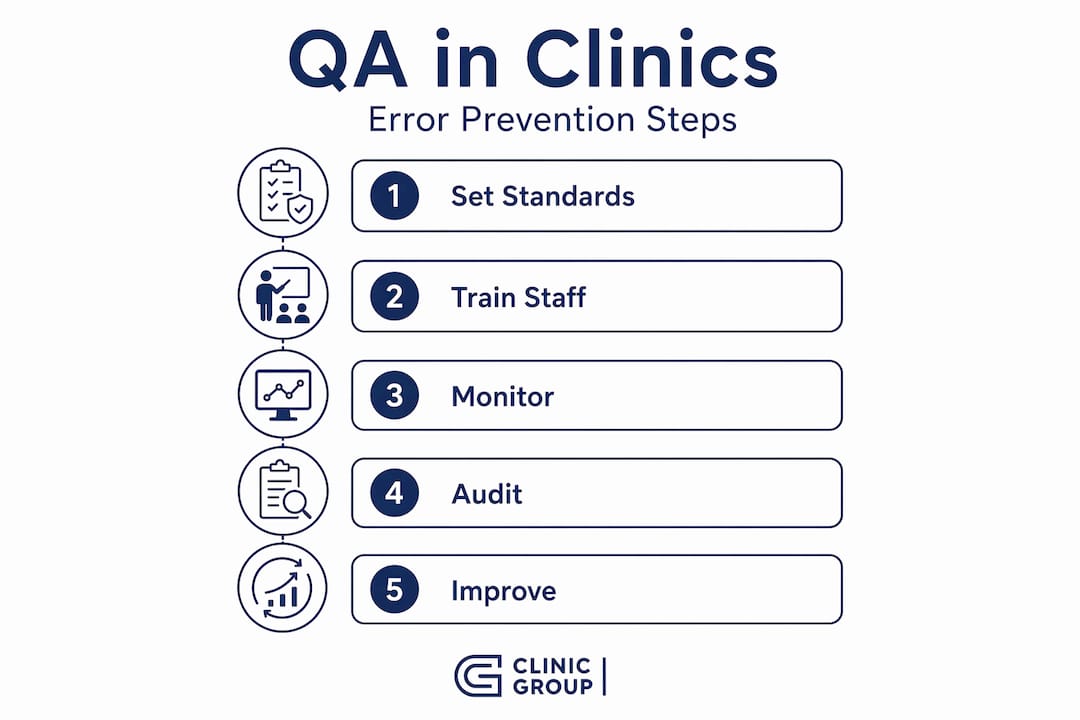
Knowing that quality assurance matters is one thing. Building a programme that actually works in a busy clinical environment is another. The best practices for clinic quality assurance share several common elements, regardless of the clinic’s size or speciality.
-
Appoint dedicated QA leadership. Quality assurance without clear ownership defaults to everyone’s lowest priority. Assign a QA lead or committee with the authority to set standards, conduct audits, and drive change. This person or team should report directly to senior management.
-
Integrate quality into daily routines. Sustainable quality improvement requires strong leadership, staff engagement, and daily clinical integration of quality standards rather than treating QA as an administrative burden. Morning briefings, shift handovers, and weekly reviews are all opportunities to embed quality thinking into normal workflow.
-
Train staff at every level. QA cannot be the exclusive domain of managers. Reception staff, nurses, technicians, and specialists all touch the patient journey at different points. Each role needs clear quality expectations and the training to meet them.
-
Conduct regular audits and root cause analysis. Scheduled clinical audits reveal where standards are slipping before they become serious problems. When incidents do occur, a thorough root cause analysis prevents recurrence by addressing systemic causes rather than individual blame.
-
Use data to drive decisions. Clinic performance evaluation techniques should be grounded in measurable indicators: appointment wait times, complication rates, patient satisfaction scores, and staff compliance with protocols. Tracking these over time reveals trends that anecdotal reporting misses.
-
Align QA goals with regulatory requirements. Quality standards should reflect national and international accreditation requirements, ensuring the clinic meets its legal obligations while also exceeding minimum thresholds wherever possible.
Pro Tip: Document the rationale behind every significant QA decision, not just the outcome. When leadership changes, undocumented decisions become invisible risks. A written record of why a protocol was set a certain way protects the clinic during transitions and inspections.
Before investing in new technology or external consultants, clinics that have not yet checked their credentials against current standards often find that basic documentation gaps are their biggest vulnerability.
Emerging technologies shaping clinic QA
The role of technology in quality assurance is growing rapidly, and clinics that ignore it risk falling behind on both efficiency and patient safety. The most significant shift is the integration of artificial intelligence and automated workflows into quality management systems.
AI should augment human decision-making in quality management rather than replace it, with phased adoption recommended for data-rich and operationally defined tasks. In practical terms, this means using AI to flag anomalies in lab results, monitor equipment calibration, and generate real-time alerts when compliance indicators fall outside acceptable ranges.
The operational gains from automation are well documented. One case study from Huntsville showed that automating QC workflows reduced manual steps from 14 to 5, cut daily staff time from 2.6 hours to 0.5 hours, and saved over $46,000 annually. Those resources were redirected to direct patient care, which is precisely where they add the most value.
| Approach | Manual QC | Automated QC |
|---|---|---|
| Daily staff time | 2.6 hours | 0.5 hours |
| Manual process steps | 14 steps | 5 steps |
| Error detection speed | Delayed | Real-time alerts |
| Audit readiness | Reactive | Continuously maintained |
| Annual cost impact | Higher | Significant savings |
Key benefits of technology-supported QA include:
- Real-time monitoring that catches compliance gaps before they escalate.
- Automated documentation that reduces the burden on clinical staff.
- Predictive analytics that identify which areas of the clinic are at highest risk.
- Digital audit trails that satisfy accreditation requirements with minimal preparation time.
Pro Tip: Start automation with the most data-rich and repetitive QC tasks, such as equipment maintenance logs and standard lab checks. These offer the fastest return and the lowest implementation risk before expanding to more complex clinical workflows.
Healthcare professionals interested in how technology connects to broader staffing and management decisions can explore resources on applying healthcare roles effectively, as quality culture depends heavily on having the right people in the right positions.
My perspective on getting QA right
I have seen enough quality programmes to know the difference between those that exist on paper and those that actually protect patients. The gap is almost always cultural, not technical.
What I have found is that clinics treat quality assurance as a project with a start and an end. They set up a system, train the staff, pass an inspection, and then let it drift. The reality is that quality assurance is continuous. It requires the same daily attention as any other clinical responsibility. The moment it becomes something you “check in on,” it starts to fail.
The finding that QA leadership transitions reveal inspection risks rather than create them is one of the most important insights in this field. When a QA lead leaves and the programme begins to unravel, the problem was never the transition. It was that the programme depended on one person’s knowledge rather than documented, embedded systems.
The same applies to the QC trap that most labs fall into: treating quality control as an event rather than a daily habit. I have seen clinics scramble before inspections, pulling together documentation that should have been maintained routinely for months. That scramble is a symptom, not a solution.
The clinics that do this well share one characteristic. Their staff at every level understand what quality means in their specific role, and they do not need to be reminded. That kind of culture is built deliberately, over time, by leadership that demonstrates the same commitment it expects from everyone else.
— Clinic
How Clinicgroup supports quality in every patient journey
At Clinicgroup, quality assurance is not a background process. It is the reason patients trust us with their care. Every clinic listed on the Clinicgroup platform has been verified against rigorous standards, with board-certified specialists and transparent pricing at the centre of every listing.
For patients seeking treatment abroad, the concern is always the same: will the quality of care meet the standards they expect at home? Clinicgroup addresses this directly. Our network spans verified clinics across Europe and the Middle East, covering treatments from dentistry and hair transplants to plastic surgery, aesthetics, and wellness. Every patient journey includes clinic matching, travel logistics, partner hotel support, and structured aftercare services to maintain quality well beyond the treatment itself.
If you are ready to explore your options with a clinic you can trust, browse the full range of available treatments or search our verified clinic directory to find specialists aligned with your needs and quality expectations.
FAQ
What is the role of quality assurance in clinics?
Quality assurance in clinics creates structured processes to prevent errors before they occur, maintain consistent care standards, and protect patient safety across every stage of the clinical journey.
How does quality assurance differ from quality control?
Quality assurance is proactive, designing systems to prevent errors, while quality control is reactive, identifying problems after they have already occurred. Both are components of a broader quality management system.
What are the measurable benefits of QA in healthcare?
Strong QA programmes reduce medical errors, lower the risk of infection, and improve patient satisfaction. Research shows that every £1 invested in quality improvements can return £3 in savings through reduced penalties and unnecessary procedures.
How can clinics start improving their QA programmes?
Clinics should begin by appointing dedicated QA leadership, integrating quality checks into daily routines, and documenting all protocols and decision rationale to maintain consistency during staff changes and inspections.
Can technology genuinely improve quality assurance in clinics?
Yes. Automated QC systems have been shown to reduce manual steps significantly and save thousands of pounds annually, while AI tools support real-time monitoring and faster clinical decision-making under human oversight.