TL;DR:
- Dental costs vary based on treatment type, location, insurance, and provider expertise, often leading to surprises. Understanding the differences between NHS, private, and insurance payment models helps patients manage expenses effectively. Choosing verified clinics abroad with transparent pricing can provide significant savings without compromising quality.
Dental bills have a reputation for being unpredictable. You arrive for what seems like a straightforward appointment and leave with a treatment plan that carries a price tag you did not anticipate. Understanding how dental pricing works is the first step toward taking control of your dental care decisions. Fees vary considerably depending on the type of treatment, the payment system in place, the clinic’s location, and whether you hold insurance. This guide breaks down the dental cost breakdown in plain terms, so you can plan ahead, ask the right questions, and avoid unnecessary financial surprises.
Table of Contents
- Key takeaways
- How dental pricing works: the core components
- Payment systems and how they affect your bill
- Dental insurance pricing explained in detail
- Factors that affect dental prices
- Practical steps for managing dental costs
- My perspective on dental pricing and transparency
- Explore dental care with Clinicgroup
- FAQ
Key takeaways
| Point | Details |
|---|---|
| Treatment type shapes the price | Preventive care costs far less than restorative or major procedures, which involve more materials and clinical time. |
| Insurance models vary significantly | UCR and MAC reimbursement methods determine how much your plan pays and how much you owe out of pocket. |
| Pretreatment estimates protect you | Requesting an itemised estimate before treatment starts helps confirm coverage and avoid unexpected charges. |
| Location and expertise affect fees | Clinic location, dentist qualifications, and technology use all contribute to differences in dental fees between providers. |
| Medical tourism offers transparent savings | Verified clinics abroad can offer substantially lower prices without compromising on clinical quality or safety. |
How dental pricing works: the core components
Pricing for dental services is not arbitrary, though it can certainly feel that way. Every fee reflects a combination of clinical factors, material costs, and the time required to deliver care safely and effectively.
Dental treatments are generally grouped into three broad categories.
- Preventive care covers check-ups, X-rays, scale and polish treatments, and fluoride applications. These tend to be the most affordable procedures because they require relatively little time and few specialist materials. Typical cash prices for preventive appointments range from approximately £60 to £160 per visit.
- Basic restorative care includes fillings, simple extractions, and minor periodontal treatments. These procedures involve more clinical complexity and material costs, placing them in a mid-range price bracket.
- Major restorative work covers crowns, bridges, root canal treatments, dental implants, and full-mouth rehabilitation. Crowns and complex restorations can run from £640 to well over £2,000 depending on materials and clinical demands.
Three core elements drive the cost of any procedure. First, the materials involved. A composite resin filling costs less than a porcelain crown because the raw material itself is more expensive to manufacture and requires precise laboratory work. Second, clinical time. A single-visit filling takes far less chair time than a multi-stage implant placement, which may require bone grafting, healing periods, and follow-up appointments across several months. Third, expertise and equipment. A specialist periodontist or oral surgeon commands higher fees than a general dentist, and clinics using digital scanning or CBCT imaging invest significantly in that technology.
Pro Tip: Always ask your dentist to categorise your planned treatment as preventive, basic, or major before your appointment. This single question can tell you immediately what level of cost and insurance coverage to expect.

Payment systems and how they affect your bill
Understanding dental fees also means understanding who is paying and through what system. The payment route you use has a direct impact on what you are charged and what you ultimately owe.
NHS versus private dentistry
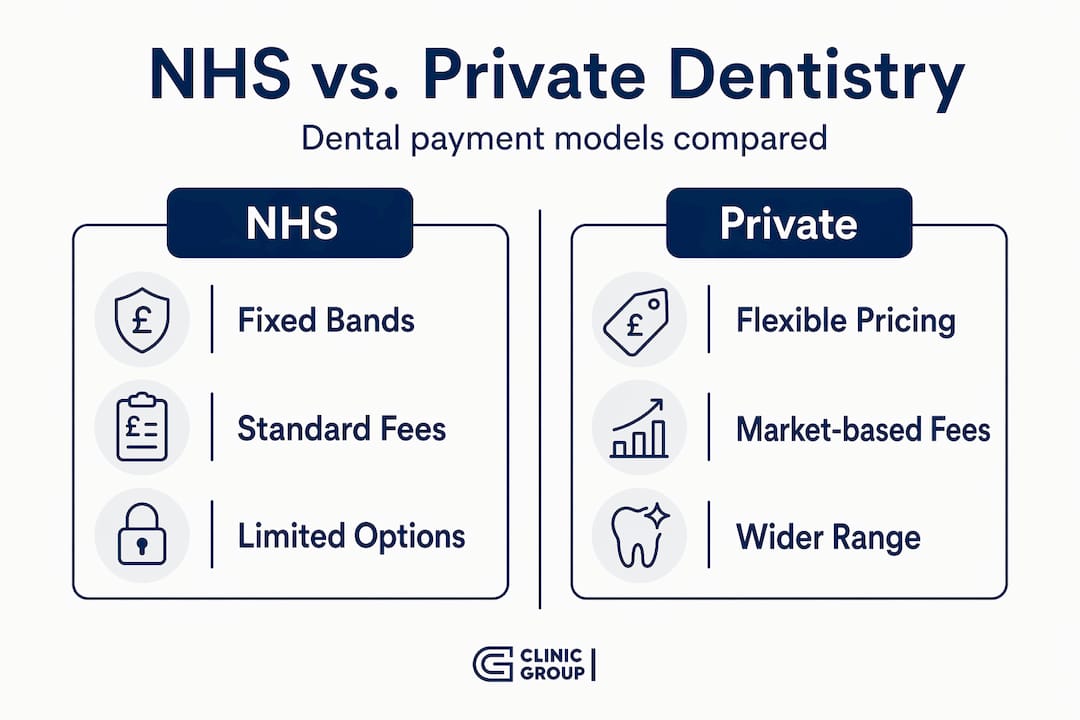
In the United Kingdom, NHS dental treatment is charged through a fixed band system. There are three bands, each covering a defined set of treatments at a set price. Band 1 covers examination and preventive care. Band 2 includes fillings and extractions. Band 3 covers crowns, dentures, and bridges. These bands provide predictability, but they also limit the range of materials and techniques available to you.
Private dentistry operates with complete pricing freedom. Practices set their own fees based on local market conditions, overhead costs, specialist qualifications, and the technology they use. Two private clinics on the same street may charge meaningfully different amounts for an identical procedure.
Insurance and out-of-pocket payment
| Payment method | How pricing is determined | Key consideration |
|---|---|---|
| NHS | Fixed government band charges | Limited treatment options within each band |
| Private (self-pay) | Clinic sets its own fees | Prices vary widely by location and provider |
| Dental insurance | Plan reimburses based on UCR or MAC | Patient pays remainder above allowed amount |
| Medical tourism | Clinic-published transparent pricing | Significant savings possible with verified providers |
Patients paying out of pocket without insurance often encounter the widest variation in fees. Clinics price according to their overheads and local market, meaning rural practices frequently charge less than urban equivalents for the same procedure. If you are self-funding treatment, comparing written quotes from multiple providers before committing is one of the most effective ways to manage costs.
Dental insurance pricing explained in detail
For many patients, dental insurance pricing explained clearly can feel like the most confusing part of the entire process. The two most common reimbursement methods used by insurers are UCR and MAC, and knowing the difference can save you a significant amount of money.
UCR: usual, customary, and reasonable fees
UCR stands for Usual, Customary, and Reasonable. Under this model, your insurer sets a benchmark fee for each procedure based on the fees charged by a majority of dentists in your geographic area. Importantly, UCR uses percentile benchmarks to determine that allowable amount. A plan using the 90th percentile reimburses more than a plan using the 70th percentile for the identical procedure, which means your out-of-pocket share depends partly on which percentile your insurer has selected.
The critical distinction to understand is that UCR is a payer benchmark, not your dentist’s actual fee. If your dentist charges above the UCR allowance, you are responsible for the difference plus your standard coinsurance amount. This is sometimes called balance billing.
MAC: maximum allowable charge
MAC plans set a flat fee schedule determined entirely by the insurer. Any dentist who accepts your plan agrees to accept the MAC fee as full payment. If you visit an out-of-network provider, they are not bound by that schedule and can bill you the difference between their fee and the MAC amount.
- Check whether your dentist is in-network under your specific plan before booking.
- Ask the practice to confirm they accept your insurer’s MAC or UCR rate as full payment.
- Request a pretreatment estimate (also called a predetermination) from your insurer before any major work begins.
- Review the estimate carefully to identify your deductible, coinsurance percentage, and annual maximum.
- Confirm that the procedure codes submitted accurately reflect the planned treatment.
Pretreatment estimates give you an itemised, plan-specific breakdown of what your insurer will cover and what you will owe before a single instrument is picked up. They are not a guarantee of payment, but they are the most reliable tool available to prevent billing surprises.
Pro Tip: Predeterminations only work effectively when your dentist submits the correct clinical procedure codes. If the submitted codes are vague or inaccurate, the estimate can be misleading. Ask the practice manager to confirm that codes match exactly what is planned.
Annual maximums are another area where patients are often caught off guard. Most dental PPO plans carry annual maximum benefits of £1,200 or more, and a growing proportion of enrollees are reaching those caps as treatment costs rise. Once you hit your annual maximum, the insurer stops paying and you cover 100% of remaining costs for the rest of that plan year.
| Insurance term | What it means | Patient impact |
|---|---|---|
| Deductible | Amount you pay before insurance contributes | Reduces coverage in early months of a plan year |
| Coinsurance | Your percentage share after deductible | Typically 20% for basic, 50% for major work |
| Annual maximum | Total insurer will pay per year | You pay all costs above this limit |
| UCR percentile | Benchmark used to set reimbursement | Higher percentile means more insurer coverage |
Factors that affect dental prices
Knowing the payment system is only part of the picture. Several practical factors determine the actual price you face, regardless of how your care is funded.
- Dentist qualifications and specialisation. A periodontist treating advanced gum disease, or an oral surgeon placing implants, will charge more than a general practitioner. Specialist training, continuing education, and postgraduate credentials all contribute to higher fees.
- Clinic location and overhead. Practices in central London or other major city centres carry higher rental costs, staffing expenses, and equipment overheads than rural or suburban practices. These costs are inevitably reflected in treatment fees. Dental fees vary by materials, time, expertise, and location.
- Materials and laboratory work. A porcelain-fused-to-zirconia crown costs more than a metal crown because the raw material, the laboratory fabrication process, and the fitting precision all require greater investment. Choosing a composite filling over an amalgam alternative, or opting for a tooth-coloured ceramic restoration, carries a premium.
- Technology and diagnostic equipment. Clinics using CBCT scanning, intraoral digital cameras, or CAD/CAM milling systems invest substantially in that infrastructure. Those costs form part of the fee schedule.
- Case complexity and number of appointments. A single implant in a healthy jaw with sufficient bone volume takes fewer appointments than an implant requiring a sinus lift or bone graft. More clinical stages mean more time, more materials, and a higher total cost.
It is also worth noting that insurance does not guarantee small bills, especially for major restorative work where coinsurance rates are higher and annual maximums are more easily reached.
Practical steps for managing dental costs
Armed with a clear understanding of how dental pricing works, there are concrete steps you can take to protect yourself financially and still receive quality care.
- Request a written estimate before treatment starts. For any procedure beyond a routine check-up, ask for a detailed quote that includes the procedure code, material specification, and total fee. For insured patients, ask the practice to submit a predetermination to your insurer at the same time.
- Ask specific questions of your insurer. Confirm your current deductible balance, your coinsurance percentage for the procedure category, your remaining annual maximum, and whether your dentist is in-network.
- Compare clinics and consider your options abroad. For major treatments such as implants, crowns, or full-arch restorations, verified international clinics can offer transparent pricing that is significantly lower than home-country equivalents, without compromising safety or quality.
- Understand what is included in a quoted price. Ask whether the quote covers consultations, X-rays, temporary restorations, and follow-up appointments, or whether these are billed separately.
Pro Tip: When considering treatment abroad, choose platforms that work exclusively with verified, accredited clinics and include logistical support. The range of treatments available through a trusted medical tourism network can be wide, covering everything from routine restorations to complex implant procedures.
My perspective on dental pricing and transparency
In my experience working with patients who are exploring dental care both at home and abroad, the single greatest source of frustration is not the cost itself. It is the feeling of being unprepared for it.
Patients who walk into a treatment plan without a clear estimate, without understanding their insurance terms, and without comparing their options are the ones who end up genuinely shocked when the final bill arrives. That shock is almost always avoidable. The information exists. It just requires the right questions and a provider willing to answer them transparently.
What I have seen repeatedly is that pretreatment estimates fail not because the system is broken, but because neither the patient nor the practice takes the time to ensure the submitted procedure codes are accurate and complete. A vague code produces a vague estimate, and a vague estimate offers false reassurance.
The medical tourism model, when done properly, actually solves much of this problem. Verified clinics abroad tend to publish clear, all-inclusive pricing because their patients are making an active, considered choice to travel. That transparency is built into the model. What Clinicgroup does is take that principle and apply it consistently, pairing patients with vetted specialists who provide detailed quotes upfront, support throughout the process, and genuine aftercare once they return home.
My view is straightforward. Transparency is not a luxury in dental care. It is what makes informed consent possible. Every patient deserves to know exactly what they are paying for before they commit.
— Clinic
Explore dental care with Clinicgroup
If you are ready to take a more informed approach to your dental care, Clinicgroup can help you access quality treatment at transparent prices. Through Clinicgroup’s network of verified dental clinics, patients from the UK and across Europe can access treatments including dental implants, crowns, veneers, and full-mouth restorations, with pricing that is clear from the start and no hidden charges added later.
Every patient journey is supported from start to finish. Clinicgroup assists with clinic matching based on your specific treatment needs, travel logistics, partner hotel arrangements, and structured aftercare follow-up. You receive a detailed cost breakdown before any commitment is made. Browse the full range of available dental treatments and find a verified specialist that matches your needs and budget.
FAQ
What are the main factors affecting dental prices?
The main factors include the type and complexity of the procedure, the materials used, the dentist’s qualifications, the clinic’s location, and whether you are using insurance, NHS, or paying privately. Fees vary by all of these elements combined.
What is the difference between UCR and MAC dental insurance?
UCR uses regional percentile benchmarks to set the maximum your insurer will pay, while MAC sets a fixed carrier fee schedule. With both models, you pay any amount your dentist charges above the allowed rate, plus your standard coinsurance.
Why is dental work expensive even with insurance?
Insurance does not eliminate costs for major work. Deductibles, coinsurance percentages, and annual maximums mean patients still pay a significant share, particularly for crowns, implants, or specialist procedures.
How do pretreatment estimates work?
A pretreatment estimate, or predetermination, is submitted by your dentist to your insurer before treatment begins. It shows what the plan will cover and what you will owe. Accuracy depends on the procedure codes submitted matching the planned work exactly.
Can I save money on dental care by going abroad?
Yes, verified clinics abroad frequently offer significantly lower prices for major dental treatments without reducing clinical standards. Using a trusted platform like Clinicgroup ensures you access accredited providers with transparent, all-inclusive pricing and full patient support throughout your journey.